Start with meaning
The public page explains the project before showing technical data.
A documentary and comparative study of patterns of passage, mediation and continuity across cultures, accounts, places, rituals, threshold experiences and human narratives.
PATHOS asks why separate cultures repeat similar forms of passage, threshold, death, mediation and continuity — and tests those repetitions before permitting any strong hypothesis.
PATHOS gathers and compares cases without automatically turning them into conclusions. The aim is to observe recurrence, test conventional explanations, distinguish candidate, pattern and hypothesis, and preserve caution before any strong claim.
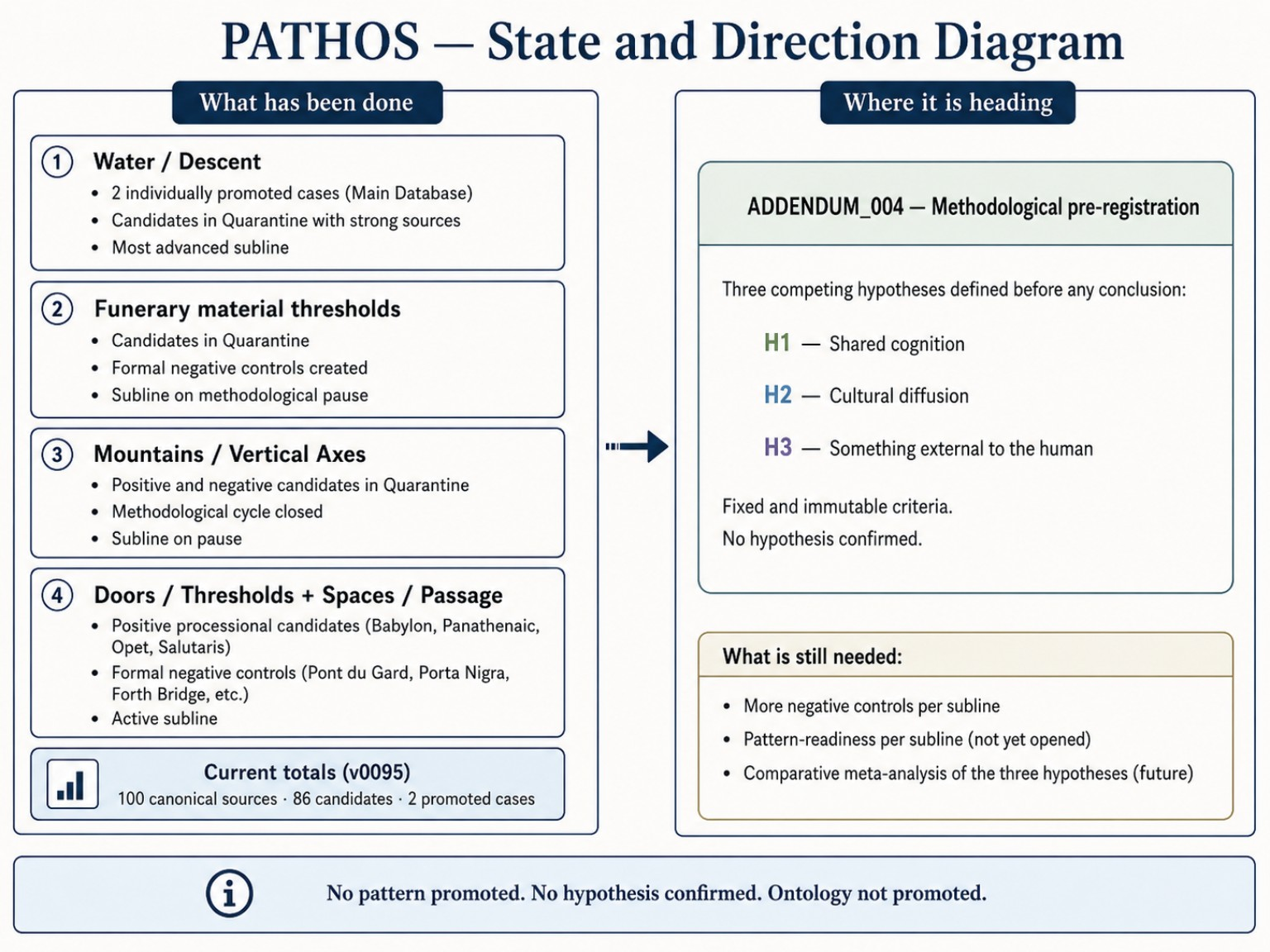
This diagram shows the current state of the PATHOS archive and its methodological direction. It does not imply a promoted pattern, confirmed hypothesis, ontological claim or causal connection between cases.
A water-centred place where human remains, offerings and ritual deposition are archaeologically documented. Conventional explanations remain active. No underworld access or ontological mediation is promoted.
A water-centred sanctuary where votive deposits and therapeutic or healing associations are documented. Functionally distinct from CASE-0001. No pattern between the two cases has been promoted.
Two individually promoted cases do not constitute a promoted pattern. Each case passed formal criteria on its own documented function. The water / threshold comparative line remains open and unresolved. Only two cases are individually promoted. Broader patterns remain unpromoted pending horizontal review and negative controls across all active research lines.
— Water / Descent: ritual use of water, caves and underground spaces
— Funerary material thresholds: material doors, false doors and funerary interfaces
— Mountains / Vertical Axes: sacred mountains, high places and ritual ascent
— Doors / Thresholds + Spaces / Passage: ritual and processional passages, formal negative controls, and candidate-design review for Opet Festival and Salutaris processional sources
— Explanatory hypothesis criteria: pre-registered in ADDENDUM_004; H1, H2 and H3 defined before pattern-readiness
The public page explains the project before showing technical data.
PATHOS crosses ancient and modern, cultural and experiential material, without collapsing them into one answer.
The site must not look like belief, dismissal, ufology, esotericism or a closed theory.
PATHOS is an attempt to organise difficult material without falling into two easy answers: believing before testing, or dismissing before understanding.
The archive brings together accounts, places, practices, texts, objects and traditions with possible comparative value.
The project observes repetition across cultures, periods and domains without assuming they all have the same origin.
Every reading must face context, limitations, conventional explanations and contrast cases.
Comparison is not conclusion. Recurrence is not proof. Hypothesis is not evidence.
The method separates levels. One case can be interesting without proving a pattern. A pattern can be strong without proving a hypothesis.
In v0080, the archive formally pre-registered three competing explanatory hypotheses (H1: shared cognition; H2: cultural diffusion; H3: something external to the human). This pre-registration defines in advance what the archive would expect to observe under each hypothesis, before the archive has sufficient mass to distinguish between them. The criteria are fixed and immutable.
A case, source, account, place or practice enters first as material to study, not as proof.
Material remains under analysis, with limits, conventional explanations and source strength.
A pattern only matures when it faces cases that look similar but do not confirm the desired reading.
Hypotheses change status only through their own demonstration. The path is slow by design.
Social function, grief, trauma, political power, local cosmology, metaphor, narrative construction and archive bias must be considered before any stronger reading.
Similar forms do not automatically mean the same function, the same origin or the same reality behind them.
Before comparing cases, PATHOS asks what documented function each case represents. A water-related deposit, a healing spring and a practical aqueduct are not the same thing merely because they all involve water.
When ancient sources describe a place as an oracle of the dead, a portal to the underworld or a site of passage, PATHOS records that cultural function. It does not treat the cultural description as proof that oracles, portals or passage were real.
Source ≠ Candidate ≠ Case ≠ Pattern ≠ Hypothesis
Source — a documented institutional or academic reference used as evidence base
Candidate (Quarantine) — a case under evaluation; not promoted
Case (Main Database) — a case that passed individual promotion criteria; not a pattern
Pattern — not yet promoted in this archive
Hypothesis — pre-registered criteria exist; no hypothesis has been confirmed
PATHOS does not belong to a single field. It crosses ancient and modern, cultural and experiential material, always with caution.
Monuments, sanctuaries, tombs, temples, wells, cenotes, caves, votive deposits and ritual architecture.
Rivers, springs, caverns, underground passages, descent, purification, concealment and invisible domains.
Portals, tunnels, corridors, thresholds, borders between inside and outside, visible and invisible.
Sacred mountains, high places, stairs, platforms, ziggurats, pyramids and ritual elevation.
Funerals, ancestors, judgement, return, rebirth, reincarnation, soul journeys and ritual memory.
Descents, psychopomps, boats, guardians, animal mediators, hybrid figures and return.
Guides, messengers, angels, demons, spirits, active dead, luminous beings and oracular figures.
Trance, dream, visions, near-death, possession, deep meditation and out-of-body experiences.
Sightings, contacts, unusual memories, entity experiences and other-domain narratives studied as reports or comparative candidates, not as literal validation.
Passage, death, return, light, water, cave, mountain, door, guardian, forgetting and rebirth.
How ancient themes reappear in contemporary spirituality, fiction, popular culture and alternative theories.
Social function, trauma, grief, politics, local cosmology, syncretism, narrative and archive bias.
Readable public histories drawn from the technical archive, written for general readers while preserving caution, traceability and methodological limits.
These texts tell documented places and practices without turning cultural belief into ontological proof. Comparison remains an interest, not a conclusion.
These cases passed formal promotion criteria as individual documented cases. They do not promote a universal pattern.
source-documented cultural function / ontology not promoted

O Cenote Sagrado fica em Chichén Itzá, no Yucatán, México, dentro de uma paisagem associada ao mundo Maya pré-hispânico. Um cenote é uma abertura natural no calcário, cheia de água, que pode funcionar ao mesmo tempo como recurso físico, ponto de orientação na paisagem e lugar carregado de significado cultural.
No caso de Chichén Itzá, o interesse histórico não está apenas na forma natural do lugar. Está no modo como esse espaço aquático foi usado, marcado e interpretado. A base PATHOS trata este caso como um lugar ritual documentado: um cenote associado a ofertas, depósitos materiais, restos humanos e leituras cosmológicas Maya. A água, aqui, não é tomada como símbolo universal por si só. O que importa é a combinação entre forma, prática, contexto e fonte.
As fontes associadas ao caso descrevem o Cenote Sagrado como um lugar de deposição ritual. Materiais preciosos e objectos orgânicos foram recuperados ou estudados em ligação com o cenote, incluindo referências a têxteis, madeira e copal preservados pela água. A documentação museológica e arqueológica também associa o local a ofertas lançadas no cenote.
O caso inclui ainda uma dimensão mais grave: estudos bioarqueológicos sobre restos humanos do Cenote Sagrado foram usados pelo PATHOS como parte do enquadramento de uma prática ritual e sacrificial/votiva. Esta dimensão deve ser lida com cuidado. Ela mostra que o lugar teve uma função social e ritual forte; não autoriza, por si só, uma leitura única ou total sobre todos os sentidos do cenote.
O que se vê, portanto, não é apenas uma massa de água natural. É um lugar onde a paisagem, a profundidade, o risco, a oferta e a memória material se juntaram numa prática cultural concreta.
Na leitura registada pelas fontes PATHOS, o Cenote Sagrado surge como lugar de oferta e como espaço liminar dentro de um horizonte Maya. A fonte museológica principal descreve cenotes como espaços importantes na cosmologia Maya e como lugares de fronteira simbólica entre o mundo terrestre e uma dimensão aquática subterrânea.
Esta formulação deve ser entendida historicamente. O PATHOS pode registar que o lugar foi interpretado culturalmente como limiar, espaço sagrado ou ponto de relação com uma geografia cosmológica. Mas isso não equivale a afirmar que o cenote fosse, em termos factuais, uma passagem real para outro mundo.
A função cultural documentada é suficiente para tornar o caso importante: água profunda, deposição ritual, oferta, restos humanos, paisagem sagrada e linguagem de limiar aparecem aqui ligados por fontes concretas. A conclusão permanece limitada ao que essas fontes permitem dizer.
Este caso interessa ao PATHOS porque mostra, com boa robustez documental, como um elemento natural — um cenote — pode tornar-se um lugar ritual organizado. A água não é tratada apenas como substância ou recurso. No contexto documentado, ela participa de uma prática de oferta, de uma relação com a profundidade e de uma forma cultural de pensar fronteiras.
O caso também é útil porque obriga a disciplina comparativa. Seria fácil transformar qualquer água profunda, poço, gruta ou fonte num sinal automático de “submundo” ou “passagem”. O próprio PATHOS impede esse salto. O Cenote Sagrado só interessa porque há documentação específica sobre o seu uso ritual, os seus depósitos e o seu enquadramento cultural.
Comparações futuras podem aproximá-lo de outros casos de água, profundidade, limiar, oferta ou morte. Mas essas aproximações devem ser lentas. Um cenote Maya com restos humanos e depósitos rituais não é a mesma coisa que uma nascente terapêutica etrusco-romana, um aqueduto romano ou uma cisterna defensiva. A semelhança formal — haver água — não basta. A função documentada vem primeiro.
Este texto não prova que o Cenote Sagrado fosse uma porta real para o submundo. Não prova contacto efectivo com mortos, deuses, entidades ou outros mundos. Não transforma a cosmologia Maya em facto ontológico, nem converte uma prática ritual documentada numa teoria universal sobre a água.
Também não prova um padrão comparativo geral. O caso foi promovido no PATHOS apenas como prática ritual/social/material individual documentada. A sua força está na documentação local, não numa conclusão ampla sobre todos os lugares aquáticos sagrados.
CASE-0001Sacred Cenote at Chichén Itzá as watery threshold and offering locusPATHOS_MASTER_v0095b8b5eaddb0e3201a630e6abddf2b830c461cf3f0f0b57ded202d510af6b4b7f7PATHOS_MASTER_v0095. A página pública actual está alinhada com PATHOS_MASTER_v0095 / canonical. A promoção, quando aplicável, é individual e limitada; não implica promoção de padrão, hipótese ou ontologia.Q-0061REPORT_021_PROMOTION_EXECUTION_Q0061_FIRST_MAIN_DATABASE_CASE.mdREPORT_020, ADDENDUM_002, REPORT_028, REPORT_029SRC-0061, SRC-0076, SRC-0077source-documented cultural function / ontology not promoted
The Sacred Cenote is located at Chichén Itzá, in Yucatán, Mexico, within a landscape associated with the pre-Hispanic Maya world. A cenote is a natural opening in limestone filled with water, which can function at once as a physical resource, a point of orientation in the landscape, and a place charged with cultural meaning.
In the case of Chichén Itzá, the historical interest lies not only in the natural form of the place. It lies in how that aquatic space was used, marked, and interpreted. The PATHOS base treats this case as a documented ritual place: a cenote associated with offerings, material deposits, human remains, and Maya cosmological readings. Water, here, is not treated as a universal symbol in itself. What matters is the combination of form, practice, context, and source.
The sources associated with the case describe the Sacred Cenote as a place of ritual deposition. Precious materials and organic objects have been recovered or studied in connection with the cenote, including references to textiles, wood, and copal preserved by the water. Museum and archaeological documentation also associates the place with offerings thrown into the cenote.
The case also includes a more severe dimension: bioarchaeological studies of human remains from the Sacred Cenote were used by PATHOS as part of the framing of a ritual and sacrificial/votive practice. This dimension must be read carefully. It shows that the place had a strong social and ritual function; it does not, by itself, authorize a single or total reading of all the meanings of the cenote.
What we see, then, is not only a natural body of water. It is a place where landscape, depth, risk, offering, and material memory came together in a concrete cultural practice.
In the reading recorded by the PATHOS sources, the Sacred Cenote appears as a place of offering and as a liminal space within a Maya horizon. The main museum source describes cenotes as important spaces in Maya cosmology and as places of symbolic boundary between the terrestrial world and an underground aquatic dimension.
This formulation must be understood historically. PATHOS can record that the place was culturally interpreted as a threshold, sacred space, or point of relation with a cosmological geography. But this is not the same as stating that the cenote was, in factual terms, a real passage to another world.
The documented cultural function is enough to make the case important: deep water, ritual deposition, offering, human remains, sacred landscape, and threshold language appear here linked by concrete sources. The conclusion remains limited to what those sources allow us to say.
This case matters to PATHOS because it shows, with strong documentary support, how a natural element — a cenote — can become an organized ritual place. Water is not treated only as a substance or resource. In the documented context, it participates in a practice of offering, in a relation with depth, and in a cultural way of thinking about boundaries.
The case is also useful because it forces comparative discipline. It would be easy to turn any deep water, well, cave, or spring into an automatic sign of “underworld” or “passage”. PATHOS resists that jump. The Sacred Cenote matters because there is specific documentation for its ritual use, its deposits, and its cultural framing.
Future comparisons may place it beside other cases of water, depth, threshold, offering, or death. But those comparisons must move slowly. A Maya cenote with human remains and ritual deposits is not the same thing as an Etruscan-Roman therapeutic spring, a Roman aqueduct, or a defensive cistern. Formal similarity — the presence of water — is not enough. Documented function comes first.
This text does not prove that the Sacred Cenote was a real door to the underworld. It does not prove factual contact with the dead, gods, entities, or other worlds. It does not turn Maya cosmology into ontological fact, nor does it convert a documented ritual practice into a universal theory about water.
It also does not prove a general comparative pattern. The case was promoted in PATHOS only as an individually documented ritual/social/material practice. Its strength lies in local documentation, not in a broad conclusion about all sacred aquatic places.
CASE-0001Sacred Cenote at Chichén Itzá as watery threshold and offering locusPATHOS_MASTER_v0095b8b5eaddb0e3201a630e6abddf2b830c461cf3f0f0b57ded202d510af6b4b7f7PATHOS_MASTER_v0095. The current public page is aligned with PATHOS_MASTER_v0095 / canonical. Where promotion applies, it is individual and limited; it does not imply promotion of a pattern, hypothesis, or ontology.Q-0061REPORT_021_PROMOTION_EXECUTION_Q0061_FIRST_MAIN_DATABASE_CASE.mdREPORT_020, ADDENDUM_002, REPORT_028, REPORT_029SRC-0061, SRC-0076, SRC-0077source-documented cultural function / ontology not promoted

San Casciano dei Bagni situa-se na Toscana, Itália. O caso PATHOS centra-se no Bagno Grande, um contexto arqueológico etrusco-romano organizado em torno de água termal, piscina sagrada, práticas votivas e uso ritual prolongado.
Ao contrário do Cenote Sagrado de Chichén Itzá, este não é tratado no PATHOS como caso de restos humanos, sacrifício ou paisagem Maya de limiar cosmológico. A sua importância está noutra função: a água como meio votivo, terapêutico e santuário material. O lugar interessa precisamente porque mostra que a água ritual não tem sempre a mesma função.
As fontes associadas descrevem um santuário ou espaço sagrado de longa duração, com deposições na água e uma relação forte entre corpo, saúde, esperança, oferta e autoridade ritual. A base PATHOS regista esse enquadramento como prática ritual/social/material documentada.
As fontes ligadas ao caso descrevem o Bagno Grande como uma piscina sagrada ou nascente termal em contexto de santuário. Há referência a ofertas votivas, incluindo bronzes e outros materiais depositados em relação com a água. Uma publicação arqueológica institucional sublinha a estratigrafia da piscina sagrada e o potencial das escavações para compreender o uso continuado do espaço.
A água termal é central. Não aparece apenas como recurso natural, nem apenas como cenário. Ela organiza o espaço ritual. As práticas documentadas ligam a água a deposições votivas, culto e uma moldura terapêutica ou de cura que deve ser mantida com linguagem cautelosa.
Isto não significa reconstruir cada gesto individual, cada doença, cada promessa ou cada intenção. Significa apenas que as fontes permitem ver o lugar como um santuário aquático onde oferenda, corpo e água se encontravam numa prática cultural reconhecível.
A função cultural documentada em San Casciano dei Bagni é a de um santuário votivo e terapêutico centrado na água. A piscina sagrada, a nascente termal, os depósitos materiais e o uso prolongado do espaço sustentam uma leitura de prática ritual ligada à cura ou à expectativa de cura.
Este enquadramento é importante porque é afirmativo, mas limitado. O PATHOS não precisa de transformar o lugar num “portal”, nem de o aproximar artificialmente de casos funerários ou de descida ao submundo. O que está documentado é suficientemente interessante por si: uma comunidade, durante longo tempo, organizou práticas rituais em torno de uma água considerada eficaz, sagrada ou apropriada para a mediação votiva.
A linguagem deve permanecer fonte-dependente. A dimensão terapêutica é registada como enquadramento cultural e ritual, não como prova de curas efectivas nem como reconstrução total de uma doutrina médica ou religiosa.
San Casciano dei Bagni interessa ao PATHOS por ser um caso de contraste interno. Tal como o Cenote Sagrado, envolve água, deposição e ritual. Mas a função dominante é diferente. Aqui, a água surge associada a santuário, voto e cura; não a restos humanos, sacrifício ou cosmologia Maya do submundo.
Essa diferença é metodologicamente preciosa. Ela impede que o PATHOS some casos de água como se fossem todos variantes do mesmo fenómeno. Também mostra que uma nascente, piscina, poço ou reservatório só pode ser interpretado depois de se perguntar: que função está documentada? Que práticas há? Que fontes o dizem? Que limites existem?
O caso ajuda a comparar sem confundir. Pode dialogar com outros lugares de água ritual, cura, purificação, oferta ou paisagem sagrada. Mas não confirma automaticamente um padrão água/limiar, nem transforma a presença de água em sinal de passagem entre mundos.
Este texto não conclui que San Casciano dei Bagni fosse um portal, uma entrada para o submundo ou um lugar de mediação ontológica real. Também não conclui que todas as nascentes sagradas sejam lugares de morte, passagem ou comunicação com outro domínio.
As fontes actualmente ligadas no PATHOS não atestam função funerária, descida ao submundo ou mediação ontológica para este caso. Ao mesmo tempo, essa ausência não deve ser exagerada como exclusão absoluta de todos os significados possíveis. A conclusão segura é mais estreita: trata-se de um santuário votivo/terapêutico centrado na água, documentado pelas fontes disponíveis.
CASE-0002San Casciano dei Bagni sacred spring as water-centered votive / therapeutic sanctuaryPATHOS_MASTER_v0095b8b5eaddb0e3201a630e6abddf2b830c461cf3f0f0b57ded202d510af6b4b7f7PATHOS_MASTER_v0095. A página pública actual está alinhada com PATHOS_MASTER_v0095 / canonical. A promoção, quando aplicável, é individual e limitada; não implica promoção de padrão, hipótese ou ontologia.Q-0065REPORT_025_Q0065_INDIVIDUAL_PROMOTION_EXECUTION_CASE0002.mdREPORT_020, REPORT_022, REPORT_023, REPORT_024, REPORT_028, REPORT_029SRC-0065, SRC-0078, SRC-0079source-documented cultural function / ontology not promoted
San Casciano dei Bagni is located in Tuscany, Italy. The PATHOS case centers on Bagno Grande, an Etruscan-Roman archaeological context organized around thermal water, a sacred pool, votive practices, and prolonged ritual use.
Unlike the Sacred Cenote of Chichén Itzá, this is not treated in PATHOS as a case of human remains, sacrifice, or a Maya landscape of cosmological threshold. Its importance lies in another function: water as votive, therapeutic, and sanctuary material. The place matters precisely because it shows that ritual water does not always have the same function.
The associated sources describe a long-lived sanctuary or sacred space, with depositions in the water and a strong relation between body, health, hope, offering, and ritual authority. The PATHOS base records this framing as a documented ritual/social/material practice.
The sources linked to the case describe Bagno Grande as a sacred pool or thermal spring within a sanctuary context. They refer to votive offerings, including bronzes and other materials deposited in relation to the water. An institutional archaeological publication emphasizes the stratigraphy of the sacred pool and the potential of the excavations for understanding the continued use of the space.
Thermal water is central. It does not appear only as a natural resource, or only as background. It organizes the ritual space. The documented practices connect water with votive depositions, cult, and a therapeutic or healing frame that must be kept in cautious language.
This does not mean reconstructing every individual gesture, every illness, every promise, or every intention. It only means that the sources allow us to see the place as an aquatic sanctuary where offering, body, and water met in a recognizable cultural practice.
The documented cultural function at San Casciano dei Bagni is that of a water-centered votive and therapeutic sanctuary. The sacred pool, the thermal spring, the material deposits, and the prolonged use of the space support a reading of ritual practice connected with healing or the expectation of healing.
This framing is important because it is affirmative, but limited. PATHOS does not need to turn the place into a “portal”, or to artificially draw it toward funerary cases or descents to the underworld. What is documented is interesting enough in itself: for a long time, a community organized ritual practices around water considered effective, sacred, or appropriate for votive mediation.
The language must remain source-dependent. The therapeutic dimension is recorded as a cultural and ritual framing, not as proof of effective cures and not as a total reconstruction of a medical or religious doctrine.
San Casciano dei Bagni matters to PATHOS as a case of internal contrast. Like the Sacred Cenote, it involves water, deposition, and ritual. But the dominant function is different. Here, water is associated with sanctuary, vow, and healing; not with human remains, sacrifice, or Maya cosmology of the underworld.
That difference is methodologically valuable. It prevents PATHOS from adding water cases together as though they were all variants of the same phenomenon. It also shows that a spring, pool, well, or reservoir can only be interpreted after asking: what function is documented? What practices are present? Which sources say so? What limits exist?
The case helps compare without confusing. It can enter into dialogue with other places of ritual water, healing, purification, offering, or sacred landscape. But it does not automatically confirm a water/threshold pattern, nor does it turn the presence of water into a sign of passage between worlds.
This text does not conclude that San Casciano dei Bagni was a portal, an entrance to the underworld, or a place of real ontological mediation. It also does not conclude that all sacred springs are places of death, passage, or communication with another domain.
The sources currently linked in PATHOS do not attest a funerary function, descent to the underworld, or ontological mediation for this case. At the same time, this absence should not be overstated as an absolute exclusion of all possible meanings. The secure conclusion is narrower: this is a water-centered votive/therapeutic sanctuary, documented by the available sources.
CASE-0002San Casciano dei Bagni sacred spring as water-centered votive / therapeutic sanctuaryPATHOS_MASTER_v0095b8b5eaddb0e3201a630e6abddf2b830c461cf3f0f0b57ded202d510af6b4b7f7PATHOS_MASTER_v0095. The current public page is aligned with PATHOS_MASTER_v0095 / canonical. Where promotion applies, it is individual and limited; it does not imply promotion of a pattern, hypothesis, or ontology.Q-0065REPORT_025_Q0065_INDIVIDUAL_PROMOTION_EXECUTION_CASE0002.mdREPORT_020, REPORT_022, REPORT_023, REPORT_024, REPORT_028, REPORT_029SRC-0065, SRC-0078, SRC-0079These cases are under investigation and have not passed formal promotion criteria. They are presented as documented cultural functions, not as validated ontological claims.
source-documented cultural function / ontology not promoted

Este candidato não começa por uma paisagem aberta, mas por um elemento arquitectónico funerário: a falsa porta da capela tumular de Raemkai, conservada e descrita pelo Metropolitan Museum of Art. A fonte PATHOS situa o objecto no Egipto do Império Antigo, aproximadamente entre 2446 e 2389 a.C., e identifica-o como parte de uma capela funerária.
Uma falsa porta egípcia não é uma porta comum. É uma porta representada, construída como parte de uma arquitectura ritual de túmulo. A sua importância histórica está no modo como organiza presença, ausência, oferenda e memória do morto. O leitor moderno pode ver pedra, relevo e inscrição; a função cultural antiga era mais complexa: a porta integrava uma relação ritual entre vivos e morto.
O PATHOS mantém Q-0051 em Quarantine porque a linguagem de porta, interface e mediação pode ser facilmente mal lida. O caso é forte como arquitectura funerária documentada; não deve ser transformado em prova de passagem literal entre mundos.
A falsa porta fazia parte da capela funerária de Raemkai. As fontes museológicas associam este tipo de elemento a imagens, textos e oferendas. No registo PATHOS, a porta é tratada como foco de uma prática: vivos, oferenda e morto eram colocados numa relação ritual através de uma superfície arquitectónica que parecia uma porta, mas não funcionava como entrada física comum.
A frase da fonte, segundo a qual o morto podia “vir ao encontro dos vivos”, deve ser lida dentro do seu contexto museológico e funerário. Ela descreve uma função ritual e uma crença cultural associada ao objecto. Não deve ser convertida em afirmação factual de que o morto se deslocava literalmente através da pedra.
O que acontecia ali, portanto, era uma organização ritual da relação com o morto. A oferenda, a imagem, a inscrição e a forma de porta criavam um ponto de contacto culturalmente significativo dentro do túmulo e da sua capela.
A função cultural documentada é a de uma interface funerária de oferendas. A falsa porta marcava um limiar, mas esse limiar é antes de tudo ritual, arquitectónico e social. Ela ajudava a organizar o lugar onde os vivos se relacionavam com o morto através de gestos, imagens, palavras e oferta.
Esta função é historicamente importante porque mostra que a relação vivos-morto podia ser materializada. A passagem não aparece aqui como narrativa abstracta; aparece numa peça de arquitectura funerária. O morto não é apenas lembrado em pensamento; é integrado num espaço de culto e numa economia ritual de presença, nome, imagem e alimento simbólico.
Mas o rigor exige separar função cultural de ontologia. A falsa porta pode ser descrita como limiar ritual documentado. Não pode ser apresentada como mecanismo real de trânsito pós-morte, nem como prova de comunicação efectiva entre vivos e mortos.
A falsa porta de Raemkai interessa ao PATHOS porque oferece um caso claro de limiar materializado. Ao contrário de Cara Blanca ou Acheron, este não é um caso centrado em água, gruta, rio ou lago. O limiar está numa superfície funerária construída: uma porta que não se abre como porta física, mas que organiza a relação ritual com o morto.
Isto ajuda o PATHOS a comparar formas diferentes de passagem sem as confundir. Uma falsa porta egípcia, um corredor micénico, uma gruta Maya ou uma paisagem grega de oráculo dos mortos podem todos tocar a ideia de limite. Mas cada um o faz de maneira própria, com fontes, funções e contextos diferentes.
O caso também é um aviso metodológico. A palavra “interface” é útil, mas perigosa se for lida de modo literal. No contexto PATHOS, significa função cultural documentada: uma arquitectura que organiza relação ritual. Não significa uma tecnologia, um portal real ou uma passagem ontológica.
Este texto não conclui que a falsa porta de Raemkai permitisse passagem literal do morto para o espaço dos vivos. Não prova vida após a morte, comunicação factual com mortos, nem trânsito real entre domínios. Também não permite generalizar todas as portas funerárias como equivalentes entre si.
O candidato permanece em Quarantine. A sua força está no documento museológico, na função funerária e no valor comparativo controlado. O PATHOS regista uma função cultural de limiar e oferenda; não valida a ontologia funerária como facto.
Q-0051Falsa porta egípcia como limiar funerário e interface de oferendasPATHOS_MASTER_v0095b8b5eaddb0e3201a630e6abddf2b830c461cf3f0f0b57ded202d510af6b4b7f7PATHOS_MASTER_v0095. A página pública actual está alinhada com PATHOS_MASTER_v0095 / canonical; o estatuto metodológico do texto permanece não-promocional salvo indicação expressa em contrário.RELATORIO_011_FASE_3_ENTRADA_INICIAL_ESPACOS_OBJECTOS_ARQUITECTURA.mdRELATORIO_012_FASE_3_PORTAS_LIMIARES_ENTRADAS_FUNERARIAS.md, REPORT_014_PHASE_3_SHORT_SYNTHESIS_MATERIAL_PASSAGE.md, REPORT_029_SOURCE_DOCUMENTED_CULTURAL_FUNCTIONS_APPLICATION_REVIEW.md, REPORT_030_SOURCE_DOCUMENTED_CULTURAL_FUNCTIONS_NORMALIZATION_DESIGN_REVIEW.md, REPORT_031_SOURCE_DOCUMENTED_CULTURAL_FUNCTIONS_WORDING_NORMALIZATION_EXECUTION_REPORT.md, REPORT_032_LEGACY_QUARANTINE_MARKERS_SCOPE_DESIGN_REVIEW.mdSRC-0051source-documented cultural function / ontology not promoted
This candidate begins not with an open landscape, but with a funerary architectural element: the false door from the tomb chapel of Raemkai, preserved and described by The Metropolitan Museum of Art. The PATHOS source places the object in Old Kingdom Egypt, approximately 2446–2389 B.C., and identifies it as part of a tomb chapel.
An Egyptian false door is not an ordinary door. It is a represented door, built as part of the ritual architecture of a tomb. Its historical importance lies in the way it organizes presence, absence, offering, and memory of the dead. A modern viewer may see stone, relief, and inscription; the ancient cultural function was more complex: the door formed part of a ritual relation between the living and the dead.
PATHOS keeps Q-0051 in Quarantine because language of door, interface, and mediation can easily be misread. The case is strong as documented funerary architecture; it must not be turned into proof of literal passage between worlds.
The false door formed part of Raemkai’s funerary chapel. Museum sources associate this type of element with images, texts, and offerings. In the PATHOS record, the door is treated as the focus of a practice: living people, offerings, and the deceased were placed in a ritual relation through an architectural surface that looked like a door, but did not function as an ordinary physical entrance.
The source phrase according to which the dead could “come forward to meet the living” must be read within its museological and funerary context. It describes a ritual function and a cultural belief associated with the object. It should not be converted into a factual claim that the dead literally moved through the stone.
What happened there, then, was a ritual organization of the relation with the deceased. Offering, image, inscription, and door form created a culturally meaningful point of contact within the tomb and its chapel.
The documented cultural function is that of a funerary offering interface. The false door marked a threshold, but that threshold is first of all ritual, architectural, and social. It helped organize the place where the living related to the dead through gestures, images, words, and offering.
This function is historically important because it shows that the living-dead relation could be materialized. Passage does not appear here as an abstract narrative; it appears in a piece of funerary architecture. The deceased is not only remembered in thought; the deceased is integrated into a cultic space and into a ritual economy of presence, name, image, and symbolic food.
But rigor requires separating cultural function from ontology. The false door can be described as a documented ritual threshold. It cannot be presented as a real mechanism of post-mortem transit, or as proof of effective communication between the living and the dead.
The false door of Raemkai matters to PATHOS because it offers a clear case of a materialized threshold. Unlike Cara Blanca or Acheron, this is not a case centered on water, cave, river, or lake. The threshold is in a constructed funerary surface: a door that does not open as a physical door, but organizes the ritual relation with the deceased.
This helps PATHOS compare different forms of passage without confusing them. An Egyptian false door, a Mycenaean corridor, a Maya cave, or a Greek landscape of an oracle of the dead may all touch the idea of limit. But each does so in its own way, with different sources, functions, and contexts.
The case is also a methodological warning. The word “interface” is useful, but dangerous if read literally. In the PATHOS context, it means documented cultural function: architecture that organizes ritual relation. It does not mean a technology, a real portal, or an ontological passage.
This text does not conclude that the false door of Raemkai allowed literal passage of the dead into the space of the living. It does not prove life after death, factual communication with the dead, or real transit between domains. It also does not allow all funerary doors to be generalized as equivalent to one another.
The candidate remains in Quarantine. Its strength lies in the museum record, the funerary function, and the controlled comparative value. PATHOS records a cultural function of threshold and offering; it does not validate the funerary ontology as fact.
Q-0051Falsa porta egípcia como limiar funerário e interface de oferendasPATHOS_MASTER_v0095b8b5eaddb0e3201a630e6abddf2b830c461cf3f0f0b57ded202d510af6b4b7f7PATHOS_MASTER_v0095. The current public page is aligned with PATHOS_MASTER_v0095 / canonical; the methodological status of the text remains non-promotional unless explicitly stated otherwise.RELATORIO_011_FASE_3_ENTRADA_INICIAL_ESPACOS_OBJECTOS_ARQUITECTURA.mdRELATORIO_012_FASE_3_PORTAS_LIMIARES_ENTRADAS_FUNERARIAS.md, REPORT_014_PHASE_3_SHORT_SYNTHESIS_MATERIAL_PASSAGE.md, REPORT_029_SOURCE_DOCUMENTED_CULTURAL_FUNCTIONS_APPLICATION_REVIEW.md, REPORT_030_SOURCE_DOCUMENTED_CULTURAL_FUNCTIONS_NORMALIZATION_DESIGN_REVIEW.md, REPORT_031_SOURCE_DOCUMENTED_CULTURAL_FUNCTIONS_WORDING_NORMALIZATION_EXECUTION_REPORT.md, REPORT_032_LEGACY_QUARANTINE_MARKERS_SCOPE_DESIGN_REVIEW.mdSRC-0051source-documented cultural function / ontology not promoted
Cara Blanca situa-se em Belize, dentro de uma paisagem arqueológica ligada ao mundo Maya. O caso PATHOS centra-se em grutas, piscinas naturais e arquitectura ritual associada a um chamado templo de água. A fonte principal é um artigo arqueológico peer-reviewed de Lisa J. Lucero e Andrew Kinkella, publicado em 2015, que trata Cara Blanca como um contexto de peregrinação e de relação cultural com o submundo Maya.
O interesse histórico do lugar não está apenas na presença de água. Está na combinação entre abertura terrestre, profundidade, grutas, piscinas naturais, arquitectura e prática ritual. A base PATHOS mantém este candidato em Quarantine precisamente porque o tema é forte, mas interpretativamente sensível: a fonte usa linguagem de portalidade e submundo, mas essa linguagem deve ser lida como enquadramento cultural documentado, não como afirmação factual de uma passagem real.
Cara Blanca é, portanto, um caso de paisagem ritual. A água e a gruta não são tratadas como símbolos automáticos. Só interessam porque aparecem ligadas a um contexto arqueológico específico e a uma interpretação académica identificável.
A fonte associada descreve Cara Blanca através de grutas, piscinas naturais e arquitectura ritual relacionada com água. O caso é enquadrado como peregrinação até uma margem ou fronteira simbólica do submundo aquático Maya. O PATHOS regista esse enquadramento com cautela: o que se documenta é uma prática e uma leitura cultural, não a existência literal de um domínio subterrâneo acessível.
A paisagem parece reunir vários elementos que, em conjunto, davam peso ritual ao lugar: água, cavidade, deslocação, arquitectura e contexto de crise ou necessidade, incluindo referências a seca, deuses, ancestrais e resposta comunitária. O importante é não separar artificialmente esses elementos. A água sem o contexto não basta. A gruta sem a prática também não basta. A força do caso está na combinação entre forma, função, contexto e fonte.
Como em outros lugares Maya com água profunda ou subterrânea, há risco de leitura rápida: ver uma piscina natural ou uma gruta e chamar-lhe logo “portal”. A disciplina PATHOS exige o contrário. O termo só pode aparecer como linguagem cultural ou académica registada pela fonte, e não como descrição factual do mundo.
A função cultural documentada em Cara Blanca é a de um lugar aquático e subterrâneo ritualmente estruturado. A fonte PATHOS associa grutas e piscinas naturais a um horizonte Maya no qual o submundo, a água, os deuses, os ancestrais e a peregrinação podiam fazer parte de uma mesma geografia ritual.
Isto não significa que o PATHOS esteja a validar a existência do submundo Maya como facto ontológico. Significa apenas que, dentro da cultura e da interpretação arqueológica registadas, aquele tipo de lugar podia ser tratado como fronteira, ponto de aproximação ou espaço de comunicação ritual com domínios que a própria cultura descrevia através de linguagem cosmológica.
A função cultural é suficientemente importante sem ser ampliada. Cara Blanca mostra que uma paisagem natural pode ser transformada por prática, arquitectura e narrativa ritual. Mas a conclusão deve ficar onde as fontes a sustentam: trata-se de portalidade culturalmente documentada, não de portal real.
Cara Blanca interessa ao PATHOS porque testa uma zona de risco central: água, gruta, profundidade e submundo aparecem juntos, mas não podem ser transformados num padrão promovido. O candidato ajuda a observar como certas culturas podem organizar ritualmente a relação entre superfície, água, descida e mundo subterrâneo imaginado ou descrito pela tradição.
Ao mesmo tempo, o caso obriga a comparar devagar. Cara Blanca pode dialogar com o Cenote Sagrado de Chichén Itzá, porque ambos pertencem a contextos Maya e envolvem água, profundidade e ritual. Mas não são o mesmo lugar, nem a mesma evidência. Também pode ser posto ao lado de Acheron, poços rituais ou nascentes votivas, mas apenas como comparação controlada de funções, nunca como prova de uma mesma realidade escondida.
O valor do candidato está precisamente nessa tensão. Ele é forte o suficiente para interessar ao PATHOS, mas delicado o suficiente para permanecer em Quarantine. Ajuda a estudar linguagem de limiar, submundo e água sem promover uma hipótese geral sobre portais, mediação ontológica ou memória ritual universal.
Este texto não conclui que Cara Blanca fosse um portal real para o submundo. Não afirma acesso factual a outro mundo, contacto real com deuses ou ancestrais, nem mediação ontológica efectiva. Também não transforma a cosmologia Maya numa descrição factual do universo.
O candidato não promove um padrão água/gruta/submundo. Não prova origem comum profunda, memória cultural ritualizada, sistema universal de passagem ou qualquer hipótese maximal. O que se pode dizer, com segurança, é mais limitado e mais útil: há uma função cultural documentada, em contexto Maya específico, na qual grutas, piscinas naturais, água, peregrinação e submundo aparecem associados por fonte arqueológica peer-reviewed.
Q-0055Cara Blanca: caves, pools e templo de água Maya como limiar para o underworldPATHOS_MASTER_v0095b8b5eaddb0e3201a630e6abddf2b830c461cf3f0f0b57ded202d510af6b4b7f7PATHOS_MASTER_v0095. A página pública actual está alinhada com PATHOS_MASTER_v0095 / canonical; o estatuto metodológico do texto permanece não-promocional salvo indicação expressa em contrário.REPORT_027_WATER_THRESHOLD_FUNCTIONAL_CLASSIFICATION_APPLICATION_REVIEW.mdRELATORIO_011_FASE_3_ENTRADA_INICIAL_ESPACOS_OBJECTOS_ARQUITECTURA.md, REPORT_013_PHASE_3_WATER_CAVES_UNDERWORLD_DESCENT.md, REPORT_022_WATER_THRESHOLD_CONTRAST_REVIEW.md, REPORT_026_WATER_THRESHOLD_FUNCTIONAL_CLASSIFICATION_REVIEW.md, REPORT_028_SOURCE_DOCUMENTED_CULTURAL_FUNCTIONS_WITH_NON_PROMOTED_ONTOLOGY.md, REPORT_029_SOURCE_DOCUMENTED_CULTURAL_FUNCTIONS_APPLICATION_REVIEW.md, REPORT_032_LEGACY_QUARANTINE_MARKERS_SCOPE_DESIGN_REVIEW.mdSRC-0055source-documented cultural function / ontology not promoted
Cara Blanca is located in Belize, within an archaeological landscape connected to the Maya world. The PATHOS candidate focuses on caves, natural pools, and ritual architecture associated with what the main source describes as an ancient Maya water temple. The principal source is a peer-reviewed archaeological article by Lisa J. Lucero and Andrew Kinkella, published in 2015, which frames Cara Blanca in relation to pilgrimage and the Maya underworld.
The historical interest of the place does not lie simply in the presence of water. It lies in the combination of terrestrial opening, depth, caves, pools, architecture, and ritual practice. PATHOS keeps this candidate in Quarantine precisely because the theme is strong but interpretively sensitive: the source uses language of portals and underworld, but that language must be treated as documented cultural framing, not as a factual statement about a real passage.
Cara Blanca is therefore a ritual landscape case. Water and cave are not treated as automatic symbols. They matter only because they appear within a specific archaeological context and a named scholarly interpretation.
The linked source describes Cara Blanca through caves, pools, and ritual architecture connected with water. The case is framed as pilgrimage toward an edge or symbolic boundary of the watery Maya underworld. PATHOS records that framing carefully: what is documented is a practice and a cultural interpretation, not the literal existence of an accessible subterranean realm.
The landscape seems to bring together several elements that gave ritual weight to the place: water, cavity, movement, architecture, and a context of crisis or need, including references to drought, gods, ancestors, and community response. The key point is not to separate these elements artificially. Water without context is not enough. A cave without practice is not enough either. The strength of the case lies in the combination of form, function, context, and source.
As with other Maya places involving deep or subterranean water, there is a risk of quick interpretation: seeing a pool or a cave and immediately calling it a “portal”. PATHOS discipline requires the opposite. The term can appear only as cultural or scholarly language recorded by the source, not as a factual description of the world.
The documented cultural function at Cara Blanca is that of a ritually structured aquatic and subterranean place. The PATHOS source links caves and pools to a Maya horizon in which the underworld, water, gods, ancestors, and pilgrimage could belong to a single ritual geography.
This does not mean that PATHOS validates the Maya underworld as an ontological fact. It means only that, within the culture and archaeological interpretation recorded by the source, this kind of place could be treated as a boundary, point of approach, or space of ritual communication with domains described by that culture through cosmological language.
The cultural function is important enough without being enlarged. Cara Blanca shows how a natural landscape can be transformed by practice, architecture, and ritual narrative. But the conclusion must remain where the sources support it: culturally documented portal language, not a real portal.
Cara Blanca matters to PATHOS because it tests a central zone of risk: water, cave, depth, and underworld appear together, but they must not be turned into a promoted pattern. The candidate helps observe how some cultures may ritually organize the relation between surface, water, descent, and an underground world imagined or described by tradition.
At the same time, the case forces slow comparison. Cara Blanca can be discussed alongside the Sacred Cenote of Chichén Itzá, because both belong to Maya contexts and involve water, depth, and ritual. But they are not the same place and not the same evidence. It can also be compared with Acheron, ritual wells, or votive springs, but only as a controlled comparison of functions, never as proof of a single hidden reality.
The value of the candidate lies precisely in that tension. It is strong enough to interest PATHOS, but sensitive enough to remain in Quarantine. It helps study threshold language, underworld framing, and water without promoting a general hypothesis about portals, ontological mediation, or universal ritual memory.
This text does not conclude that Cara Blanca was a real portal to the underworld. It does not claim factual access to another world, real contact with gods or ancestors, or effective ontological mediation. It also does not turn Maya cosmology into a factual description of the universe.
The candidate does not promote a water/cave/underworld pattern. It does not prove deep common origin, ritualized cultural memory, a universal passage system, or any maximal hypothesis. What can be said safely is narrower and more useful: there is a documented cultural function, in a specific Maya context, in which caves, pools, water, pilgrimage, and underworld language are associated by a peer-reviewed archaeological source.
Q-0055Cara Blanca: caves, pools e templo de água Maya como limiar para o underworldPATHOS_MASTER_v0095b8b5eaddb0e3201a630e6abddf2b830c461cf3f0f0b57ded202d510af6b4b7f7PATHOS_MASTER_v0095. The current public page is aligned with PATHOS_MASTER_v0095 / canonical; the methodological status of the text remains non-promotional unless explicitly stated otherwise.REPORT_027_WATER_THRESHOLD_FUNCTIONAL_CLASSIFICATION_APPLICATION_REVIEW.mdRELATORIO_011_FASE_3_ENTRADA_INICIAL_ESPACOS_OBJECTOS_ARQUITECTURA.md, REPORT_013_PHASE_3_WATER_CAVES_UNDERWORLD_DESCENT.md, REPORT_022_WATER_THRESHOLD_CONTRAST_REVIEW.md, REPORT_026_WATER_THRESHOLD_FUNCTIONAL_CLASSIFICATION_REVIEW.md, REPORT_028_SOURCE_DOCUMENTED_CULTURAL_FUNCTIONS_WITH_NON_PROMOTED_ONTOLOGY.md, REPORT_029_SOURCE_DOCUMENTED_CULTURAL_FUNCTIONS_APPLICATION_REVIEW.md, REPORT_032_LEGACY_QUARANTINE_MARKERS_SCOPE_DESIGN_REVIEW.mdSRC-0055source-documented cultural function / ontology not promoted

O candidato Q-0063 centra-se no Acheron e no Nekromanteion, no noroeste da Grécia, numa paisagem associada a rio, lago ou zona húmida, e à tradição grega de Hades. A fonte PATHOS é uma página arqueológica institucional do Ministério da Cultura grego / portal Odysseus, registada como fonte sobre o Nekromanteion de Acheron.
O interesse histórico do lugar nasce da junção entre geografia e tradição. A paisagem aquática não é apenas cenário; é registada como parte de uma geografia cultural em que o Acheron e a região da lagoa Acherousian se ligam à ideia de aproximação ao mundo dos mortos. O Nekromanteion aparece, na fonte institucional, como oráculo dos mortos no mundo grego antigo.
Essa formulação exige cuidado. O PATHOS pode contar que a tradição grega associava aquele lugar ao Hades e à consulta dos mortos. Não pode afirmar que havia contacto factual com mortos, nem que o sítio dava acesso real a outro domínio.
A tradição associada ao Nekromanteion envolve consulta oracular aos mortos. Em termos públicos, isto deve ser explicado como prática cultural e institucional atribuída ao mundo grego antigo: pessoas procuravam uma forma ritualizada de relação com os mortos dentro de uma paisagem já carregada de significado mítico e geográfico.
O elemento aquático é importante, mas não funciona sozinho. O Acheron, a lagoa e a fronteira húmida ajudam a configurar o lugar como paisagem de limite. Ao mesmo tempo, o oráculo dos mortos pertence a uma tradição literária, ritual e histórica específica. A água pode marcar fronteira física, risco ou separação; a associação com os mortos depende da cultura e das fontes.
A própria base PATHOS regista limitações: a página institucional directa esteve intermitentemente indisponível durante a recolha e a identificação arqueológica deve ser revista antes de qualquer promoção futura. Esta cautela não elimina o interesse do candidato, mas impede que ele seja apresentado como caso fechado ou como prova forte.
A função cultural documentada é a de uma paisagem grega em que água, limite, Hades e oráculo dos mortos aparecem associados. O lugar funciona, no registo cultural, como ponto de aproximação ritual ao domínio dos mortos. Mas essa função é histórica, institucional e tradicional; não é validação de comunicação real.
O PATHOS regista a fórmula “oráculo dos mortos” como uma função cultural documentada. Isto significa que a tradição e a fonte tratam o lugar nesses termos. Não significa que as respostas obtidas fossem efectivamente dadas por mortos, nem que o Hades seja tratado como geografia factual.
O valor do caso está em mostrar como uma paisagem concreta podia ser investida de sentido funerário, oracular e cosmológico. O rio ou lago não é apenas uma forma natural; dentro desta tradição, torna-se parte de uma fronteira cultural entre vivos, mortos e memória ritual.
Acheron e Nekromanteion interessam ao PATHOS porque testam a relação entre água, paisagem de fronteira e morte. Ao contrário de San Casciano dei Bagni, a função dominante aqui não é terapêutica ou votiva de cura. Ao contrário de Cara Blanca, o enquadramento não é Maya nem centrado em grutas e templo de água. Aqui, o foco é grego: rio/lago, Hades, oráculo e mortos.
O caso ajuda a perceber que a água pode adquirir funções culturais muito diferentes. Pode ser cura, oferta, armazenamento, perigo, fronteira ou geografia do além, dependendo das fontes. A presença de água não basta para concluir nada; é a tradição associada ao lugar que dá ao Acheron o seu peso específico.
Para o PATHOS, este candidato deve continuar a ser comparativo, não conclusivo. Ele pode dialogar com outros casos de água e morte, mas não confirma um padrão universal de travessia aquática, nem prova que rios ou lagos funcionem como acesso real ao mundo dos mortos.
Este texto não conclui que o Nekromanteion permitisse comunicação factual com mortos. Não afirma acesso real ao Hades, passagem literal para o submundo, nem mediação ontológica efectiva. Também não transforma a tradição grega numa chave universal para interpretar todas as águas associadas à morte.
O candidato permanece em Quarantine. A sua força é cultural e documental, mas a sua leitura requer controlo: recepção posterior, turismo, tradição literária e identificação arqueológica precisam de ser separados sempre que o caso for usado. O PATHOS regista a função oracular documentada; não valida a ontologia descrita.
Q-0063Acheron and the Nekromanteion as river-lake boundary and oracle of the deadPATHOS_MASTER_v0095b8b5eaddb0e3201a630e6abddf2b830c461cf3f0f0b57ded202d510af6b4b7f7PATHOS_MASTER_v0095. A página pública actual está alinhada com PATHOS_MASTER_v0095 / canonical; o estatuto metodológico do texto permanece não-promocional salvo indicação expressa em contrário.REPORT_027_WATER_THRESHOLD_FUNCTIONAL_CLASSIFICATION_APPLICATION_REVIEW.mdREPORT_013_PHASE_3_WATER_CAVES_UNDERWORLD_DESCENT.md, REPORT_014_PHASE_3_SHORT_SYNTHESIS_MATERIAL_PASSAGE.md, REPORT_018_PHASE_3_HORIZONTAL_REVIEW_WATER_SUBLINE.md, REPORT_022_WATER_THRESHOLD_CONTRAST_REVIEW.md, REPORT_023_WATER_THRESHOLD_PATTERN_CRITERIA_HIERARCHY.md, REPORT_026_WATER_THRESHOLD_FUNCTIONAL_CLASSIFICATION_REVIEW.md, REPORT_028_SOURCE_DOCUMENTED_CULTURAL_FUNCTIONS_WITH_NON_PROMOTED_ONTOLOGY.md, REPORT_029_SOURCE_DOCUMENTED_CULTURAL_FUNCTIONS_APPLICATION_REVIEW.md, REPORT_032_LEGACY_QUARANTINE_MARKERS_SCOPE_DESIGN_REVIEW.mdSRC-0063source-documented cultural function / ontology not promoted
Candidate Q-0063 focuses on Acheron and the Nekromanteion in northwestern Greece, in a landscape associated with river, lake, or wetland, and with the Greek tradition of Hades. The PATHOS source is an institutional archaeological page from the Greek Ministry of Culture / Odysseus portal, recorded as a source on the Nekromanteion of Acheron.
The historical interest of the place comes from the meeting of geography and tradition. The aquatic landscape is not merely background; it is recorded as part of a cultural geography in which Acheron and the area of the Acherousian Lake are linked to the idea of approaching the world of the dead. In the institutional source, the Nekromanteion appears as an oracle of the dead in the ancient Greek world.
That formulation requires care. PATHOS can say that Greek tradition associated the place with Hades and consultation of the dead. It cannot state that there was factual contact with the dead, or that the site gave real access to another domain.
The tradition associated with the Nekromanteion involves oracular consultation of the dead. For public writing, this should be explained as a cultural and institutional practice attributed to the ancient Greek world: people sought a ritualized form of relation with the dead within a landscape already charged with mythic and geographic meaning.
The aquatic element matters, but it does not work alone. Acheron, the lake, and the wet boundary help configure the place as a landscape of limit. At the same time, the oracle of the dead belongs to a specific literary, ritual, and historical tradition. Water may mark physical boundary, danger, or separation; its association with the dead depends on culture and sources.
The PATHOS base itself records limitations: the direct institutional page was intermittently unavailable during retrieval, and the archaeological identification should be reviewed before any future promotion. This caution does not remove the candidate’s interest, but it prevents the site from being presented as a closed case or as strong proof.
The documented cultural function is that of a Greek landscape in which water, boundary, Hades, and oracle of the dead appear together. In cultural terms, the place functions as a ritual point of approach to the domain of the dead. But that function is historical, institutional, and traditional; it is not validation of real communication.
PATHOS records the phrase “oracle of the dead” as a documented cultural function. This means that the tradition and the source treat the place in those terms. It does not mean that the answers were in fact given by the dead, or that Hades is treated as factual geography.
The value of the case lies in showing how a concrete landscape could be invested with funerary, oracular, and cosmological meaning. The river or lake is not merely a natural form; within this tradition, it becomes part of a cultural boundary between the living, the dead, and ritual memory.
Acheron and the Nekromanteion matter to PATHOS because they test the relation between water, boundary landscape, and death. Unlike San Casciano dei Bagni, the dominant function here is not therapeutic or healing-votive. Unlike Cara Blanca, the framing is not Maya and not centered on caves and a water temple. Here the focus is Greek: river/lake, Hades, oracle, and the dead.
The case helps show that water can acquire very different cultural functions. It may be healing, offering, storage, danger, boundary, or geography of the afterlife, depending on the sources. The presence of water is not enough to conclude anything; it is the tradition attached to the place that gives Acheron its specific weight.
For PATHOS, this candidate must remain comparative, not conclusive. It can be discussed alongside other cases of water and death, but it does not confirm a universal pattern of aquatic crossing, nor does it prove that rivers or lakes function as real access to the world of the dead.
This text does not conclude that the Nekromanteion enabled factual communication with the dead. It does not claim real access to Hades, literal passage to the underworld, or effective ontological mediation. It also does not turn Greek tradition into a universal key for interpreting all waters associated with death.
The candidate remains in Quarantine. Its strength is cultural and documentary, but its reading requires control: later reception, tourism, literary tradition, and archaeological identification must be kept separate whenever the case is used. PATHOS records the documented oracular function; it does not validate the described ontology.
Q-0063Acheron and the Nekromanteion as river-lake boundary and oracle of the deadPATHOS_MASTER_v0095b8b5eaddb0e3201a630e6abddf2b830c461cf3f0f0b57ded202d510af6b4b7f7PATHOS_MASTER_v0095. The current public page is aligned with PATHOS_MASTER_v0095 / canonical; the methodological status of the text remains non-promotional unless explicitly stated otherwise.REPORT_027_WATER_THRESHOLD_FUNCTIONAL_CLASSIFICATION_APPLICATION_REVIEW.mdREPORT_013_PHASE_3_WATER_CAVES_UNDERWORLD_DESCENT.md, REPORT_014_PHASE_3_SHORT_SYNTHESIS_MATERIAL_PASSAGE.md, REPORT_018_PHASE_3_HORIZONTAL_REVIEW_WATER_SUBLINE.md, REPORT_022_WATER_THRESHOLD_CONTRAST_REVIEW.md, REPORT_023_WATER_THRESHOLD_PATTERN_CRITERIA_HIERARCHY.md, REPORT_026_WATER_THRESHOLD_FUNCTIONAL_CLASSIFICATION_REVIEW.md, REPORT_028_SOURCE_DOCUMENTED_CULTURAL_FUNCTIONS_WITH_NON_PROMOTED_ONTOLOGY.md, REPORT_029_SOURCE_DOCUMENTED_CULTURAL_FUNCTIONS_APPLICATION_REVIEW.md, REPORT_032_LEGACY_QUARANTINE_MARKERS_SCOPE_DESIGN_REVIEW.mdSRC-0063source-documented cultural function / ontology not promoted

Gebel Barkal situa-se no Sudão, na região napata, dentro de uma paisagem arqueológica do vale do Nilo. A fonte PATHOS associada é a página da UNESCO sobre “Gebel Barkal and the Sites of the Napatan Region”, inscrita na Lista do Património Mundial em 2003.
A fonte descreve Gebel Barkal como uma montanha de arenito com cerca de 100 metros de altura, marcada por templos, tradição religiosa, realeza e arquitectura funerária. A mesma fonte regista que a montanha foi considerada sagrada desde tempos do Novo Império e que Amun era acreditado como residente naquela montanha santa.
É aqui que a cautela começa. O PATHOS pode dizer que Gebel Barkal foi tratado como montanha sagrada e morada divina dentro de uma tradição político-religiosa documentada. Não pode afirmar que Amun residisse ali como facto ontológico. A força do caso está no cruzamento entre paisagem, culto, poder e crença documentada.
A paisagem de Gebel Barkal reuniu montanha, templos, realeza, culto de Amun e memória política. A fonte UNESCO liga o monte a uma tradição longa, com templos construídos ao pé da colina e com uma relação estreita entre o lugar, a religião de Estado e a legitimidade régia.
Neste caso, a verticalidade é importante, mas não deve ser exagerada. Gebel Barkal é uma presença física forte: uma montanha visível, distinta, territorialmente marcante. Mas a sua função ritual não vem apenas da altura. Vem do facto de ter sido integrado numa paisagem sagrada e política, com templos, arquitectura e uma tradição que ligava o lugar a Amun.
O que se observa, portanto, não é uma montanha isolada com “simbolismo universal”. É um lugar concreto, situado no vale do Nilo, onde forma natural, construção ritual e poder político foram historicamente articulados.
A função cultural documentada de Gebel Barkal é a de montanha sagrada, associada à presença de Amun e à legitimação político-ritual napata/kushita em diálogo com tradições egípcias. A fonte regista uma crença: Amun era acreditado como residente na montanha. O PATHOS pode preservar esta formulação enquanto crença e função cultural; não a converte em facto ontológico.
Este caso mostra como uma paisagem pode organizar poder. A montanha não é apenas lugar de culto, mas também marcador territorial, político e dinástico. A ideia de morada divina reforça a autoridade do lugar e, por extensão, a autoridade daqueles que se relacionam ritualmente com ele.
A função cultural é, por isso, dupla: sagrada e política. Gebel Barkal ajuda a perceber como uma forma natural pode ser tomada como centro de culto, memória e legitimidade. Mas a análise continua histórica: não valida residência divina literal.
Gebel Barkal interessa ao PATHOS porque testa a verticalidade e a montanha como formas materiais de mediação cultural. Diferente dos casos de água ou de falsa porta, aqui a questão não é descida, piscina, rio, oferenda aquática ou superfície funerária. A questão é elevação, visibilidade, sacralidade e poder.
O caso é valioso porque a fonte suporta explicitamente a linguagem de montanha sagrada e morada divina. Ao mesmo tempo, é perigoso porque essa linguagem pode ser rapidamente transformada em “axis mundi” universal, eixo céu-terra ou prova de mediação real. O relatório PATHOS sobre montanhas insiste precisamente nesta distinção: verticalidade, ascensão e mediação não são a mesma coisa.
Comparações futuras podem aproximar Gebel Barkal de outras montanhas sagradas, cumes rituais, templos ou paisagens de poder. Mas a comparação deve preservar o contexto: este é um caso napata/kushita e egipto-adjacente, com risco de viés de arquivo do vale do Nilo. A documentação forte não deve ser confundida com universalidade.
Este texto não conclui que Gebel Barkal fosse uma morada divina em sentido factual. Não prova presença real de Amun, mediação ontológica entre céu e terra, eixo cósmico universal, contacto real com deuses ou qualquer sistema oculto de montanhas sagradas.
O candidato permanece em Quarantine. A sua força está na documentação patrimonial, na paisagem arqueológica e na relação entre montanha, templo, Amun, realeza e legitimidade. O PATHOS regista a função cultural e política documentada; não promove a ontologia descrita.
Q-0068Gebel Barkal as sacred mountain, divine dwelling and Napatan political-ritual markerPATHOS_MASTER_v0095b8b5eaddb0e3201a630e6abddf2b830c461cf3f0f0b57ded202d510af6b4b7f7PATHOS_MASTER_v0095. A página pública actual está alinhada com PATHOS_MASTER_v0095 / canonical; o estatuto metodológico do texto permanece não-promocional salvo indicação expressa em contrário.REPORT_015_PHASE_3_MOUNTAINS_VERTICAL_AXES_HEAVEN_EARTH_MEDIATION.mdREPORT_029_SOURCE_DOCUMENTED_CULTURAL_FUNCTIONS_APPLICATION_REVIEW.md, REPORT_030_SOURCE_DOCUMENTED_CULTURAL_FUNCTIONS_NORMALIZATION_DESIGN_REVIEW.md, REPORT_031_SOURCE_DOCUMENTED_CULTURAL_FUNCTIONS_WORDING_NORMALIZATION_EXECUTION_REPORT.md, REPORT_032_LEGACY_QUARANTINE_MARKERS_SCOPE_DESIGN_REVIEW.mdSRC-0068source-documented cultural function / ontology not promoted
Gebel Barkal is located in Sudan, in the Napatan region, within an archaeological landscape of the Nile Valley. The associated PATHOS source is the UNESCO page for “Gebel Barkal and the Sites of the Napatan Region”, inscribed on the World Heritage List in 2003.
The source describes Gebel Barkal as a sandstone mountain about 100 meters high, marked by temples, religious tradition, kingship, and funerary architecture. The same source records that the mountain had been considered sacred since New Kingdom times, and that Amun was believed to reside in this holy mountain.
This is where caution begins. PATHOS can say that Gebel Barkal was treated as a sacred mountain and divine dwelling within a documented political-religious tradition. It cannot state that Amun resided there as an ontological fact. The strength of the case lies in the intersection of landscape, cult, power, and documented belief.
The landscape of Gebel Barkal brought together mountain, temples, kingship, the cult of Amun, and political memory. The UNESCO source links the mountain to a long tradition, with temples built at the foot of the hill and a close relation between the place, state religion, and royal legitimacy.
In this case, verticality matters, but it should not be exaggerated. Gebel Barkal is a strong physical presence: a visible, distinctive, territorially marked mountain. But its ritual function does not come from height alone. It comes from its integration into a sacred and political landscape, with temples, architecture, and a tradition linking the place to Amun.
What we see, therefore, is not an isolated mountain with “universal symbolism”. It is a concrete place, located in the Nile Valley, where natural form, ritual construction, and political power were historically articulated.
The documented cultural function of Gebel Barkal is that of a sacred mountain associated with the presence of Amun and with Napatan/Kushite political-ritual legitimacy in dialogue with Egyptian traditions. The source records a belief: Amun was believed to reside in the mountain. PATHOS can preserve this wording as belief and cultural function; it does not convert it into ontological fact.
This case shows how a landscape can organize power. The mountain is not only a cult place, but also a territorial, political, and dynastic marker. The idea of divine dwelling strengthens the authority of the place and, by extension, the authority of those who relate to it ritually.
The cultural function is therefore double: sacred and political. Gebel Barkal helps us understand how a natural form can be taken as a center of cult, memory, and legitimacy. But the analysis remains historical: it does not validate literal divine residence.
Gebel Barkal matters to PATHOS because it tests verticality and mountain as material forms of cultural mediation. Unlike the water cases or the false door, the question here is not descent, pool, river, aquatic offering, or funerary surface. The question is elevation, visibility, sacredness, and power.
The case is valuable because the source explicitly supports language of sacred mountain and divine dwelling. At the same time, it is dangerous because that language can quickly be turned into a universal “axis mundi”, a Heaven-Earth axis, or proof of real mediation. The PATHOS mountain report insists precisely on this distinction: verticality, ascent, and mediation are not the same thing.
Future comparisons may place Gebel Barkal alongside other sacred mountains, ritual summits, temples, or landscapes of power. But comparison must preserve context: this is a Napatan/Kushite and Egypt-adjacent case, with a Nile Valley archive-bias risk. Strong documentation must not be confused with universality.
This text does not conclude that Gebel Barkal was a divine dwelling in a factual sense. It does not prove the real presence of Amun, ontological mediation between heaven and earth, a universal cosmic axis, real contact with gods, or any hidden system of sacred mountains.
The candidate remains in Quarantine. Its strength lies in heritage documentation, the archaeological landscape, and the relation between mountain, temple, Amun, kingship, and legitimacy. PATHOS records the documented cultural and political function; it does not promote the described ontology.
Q-0068Gebel Barkal as sacred mountain, divine dwelling and Napatan political-ritual markerPATHOS_MASTER_v0095b8b5eaddb0e3201a630e6abddf2b830c461cf3f0f0b57ded202d510af6b4b7f7PATHOS_MASTER_v0095. The current public page is aligned with PATHOS_MASTER_v0095 / canonical; the methodological status of the text remains non-promotional unless explicitly stated otherwise.REPORT_015_PHASE_3_MOUNTAINS_VERTICAL_AXES_HEAVEN_EARTH_MEDIATION.mdREPORT_029_SOURCE_DOCUMENTED_CULTURAL_FUNCTIONS_APPLICATION_REVIEW.md, REPORT_030_SOURCE_DOCUMENTED_CULTURAL_FUNCTIONS_NORMALIZATION_DESIGN_REVIEW.md, REPORT_031_SOURCE_DOCUMENTED_CULTURAL_FUNCTIONS_WORDING_NORMALIZATION_EXECUTION_REPORT.md, REPORT_032_LEGACY_QUARANTINE_MARKERS_SCOPE_DESIGN_REVIEW.mdSRC-0068source-documented cultural function / ontology not promoted

Fujisan, ou Monte Fuji, situa-se no Japão e é uma das montanhas mais reconhecíveis da paisagem japonesa. A fonte PATHOS associada é a página da UNESCO “Fujisan, sacred place and source of artistic inspiration”, inscrita na Lista do Património Mundial em 2013.
A fonte descreve Fujisan como uma montanha que foi objecto de peregrinação e como uma paisagem composta por rotas de peregrinos, santuários de cratera, santuários Sengen-jinja, casas Oshi de alojamento e elementos naturais reverenciados. O interesse histórico não está apenas na altitude ou na forma vulcânica da montanha. Está no modo como essa forma foi integrada em práticas, instituições, percursos e memória cultural.
O PATHOS trata Fujisan como candidato em Quarantine. O caso permite observar uma paisagem sagrada de ascensão e peregrinação, mas não autoriza concluir que a montanha funcionasse como acesso literal ao divino ou como eixo universal entre céu e terra.
A prática documentada em Fujisan envolve peregrinação, ascensão ritualizada, santuários e infra-estrutura de apoio aos peregrinos. As rotas organizavam a aproximação à montanha; os santuários marcavam pontos de relação religiosa; as casas Oshi acolhiam e apoiavam quem participava nesse universo de peregrinação.
A ascensão é importante, mas deve ser lida como prática cultural e histórica. Subir a montanha não é, por si só, prova de mediação literal entre mundos. A subida pode organizar esforço, devoção, orientação espacial, disciplina ritual e relação com uma paisagem considerada sagrada. A sua força está no conjunto: montanha visível, rotas, santuários, alojamento, elementos naturais e recepção cultural.
Também é importante separar camadas. A fonte UNESCO regista uma paisagem patrimonial reconhecida no presente, mas essa patrimonialização moderna não deve ser confundida com a totalidade das práticas históricas. O texto público deve manter as duas coisas visíveis: a função cultural documentada e a cautela perante a leitura retrospectiva.
A função cultural documentada de Fujisan é a de montanha sagrada e paisagem de peregrinação. A montanha não aparece apenas como elevação natural, mas como centro de práticas de ascensão, santuários, rotas e reverência paisagística.
Para o PATHOS, isto é suficiente para registar uma função cultural de passagem e orientação ritual. A passagem aqui não é uma “porta” nem uma descida ao submundo. É uma forma de deslocação ascendente, ritualmente marcada, dentro de uma paisagem sagrada.
Mas esta função permanece histórica. O PATHOS pode dizer que Fujisan foi usado e compreendido como paisagem de peregrinação e lugar sagrado. Não pode afirmar que a ascensão produzisse acesso real a outro domínio, nem que a montanha prove um símbolo vertical universal.
Fujisan interessa ao PATHOS porque ajuda a distinguir três coisas que são fáceis de confundir: verticalidade física, ascensão ritual e mediação ontológica. A primeira é forma espacial. A segunda é prática cultural documentada. A terceira não é promovida.
O caso é forte como exemplo de paisagem de ascensão e peregrinação. Ele permite comparar montanhas enquanto lugares onde movimento, rota, culto e visibilidade se juntam. Mas essa comparação deve ser limitada: uma montanha sagrada japonesa não prova uma doutrina universal da montanha sagrada, nem transforma altitude em evidência de comunicação com o divino.
Fujisan também ajuda a controlar leituras excessivas da sublinha Mountains / Vertical Axes. A pergunta útil não é “todas as montanhas são axis mundi?”, mas sim: em que contextos documentados uma montanha se torna paisagem ritual, percurso de peregrinação, marcador cultural ou lugar de orientação simbólica?
Este texto não conclui que Fujisan seja um eixo cósmico universal, nem que a sua ascensão corresponda a acesso factual ao céu, a deuses ou a outro domínio. Não promove uma teoria geral da montanha sagrada, uma origem comum profunda, um sistema simbólico oculto ou uma mediação literal.
O candidato permanece em Quarantine. A sua relevância está na função cultural documentada: montanha sagrada, peregrinação, ascensão ritualizada e paisagem organizada por práticas e instituições. O PATHOS regista essa função; não promove a ontologia.
Q-0066Fujisan as sacred mountain, pilgrimage ascent and ritualized landscapePATHOS_MASTER_v0095b8b5eaddb0e3201a630e6abddf2b830c461cf3f0f0b57ded202d510af6b4b7f7SRC-0066 — UNESCO World Heritage Centre, Fujisan, sacred place and source of artistic inspiration, 2013, source strength: HighREPORT_015_PHASE_3_MOUNTAINS_VERTICAL_AXES_HEAVEN_EARTH_MEDIATION.md; REPORT_046_PHASE3_MOUNTAINS_VERTICAL_AXES_HORIZONTAL_REVIEW.md; REPORT_047_PHASE3_MOUNTAINS_VERTICAL_AXES_CONTRAST_SET_DESIGN_REVIEW.mdPATHOS_MASTER_v0095. A página pública actual está alinhada com PATHOS_MASTER_v0095 / canonical.source-documented cultural function / ontology not promoted
Fujisan, or Mount Fuji, is located in Japan and is one of the most recognizable mountains in the Japanese landscape. The associated PATHOS source is the UNESCO page “Fujisan, sacred place and source of artistic inspiration”, inscribed on the World Heritage List in 2013.
The source describes Fujisan as a mountain that has been the object of pilgrimages and as a landscape made up of pilgrim routes, crater shrines, Sengen-jinja shrines, Oshi lodging houses, and revered natural features. The historical interest does not lie only in the mountain’s height or volcanic form. It lies in the way that form was integrated into practices, institutions, routes, and cultural memory.
PATHOS treats Fujisan as a Quarantine candidate. The case allows us to observe a sacred landscape of ascent and pilgrimage, but it does not authorize the conclusion that the mountain functioned as a literal access point to the divine or as a universal axis between heaven and earth.
The documented practice at Fujisan involves pilgrimage, ritualized ascent, shrines, and infrastructure supporting pilgrims. The routes organized the approach to the mountain; the shrines marked points of religious relation; the Oshi houses hosted and supported those participating in this pilgrimage world.
Ascent matters, but it should be read as a cultural and historical practice. Climbing the mountain is not, by itself, evidence of literal mediation between worlds. Ascent can organize effort, devotion, spatial orientation, ritual discipline, and relation to a landscape considered sacred. Its strength lies in the whole: visible mountain, routes, shrines, lodging, natural features, and cultural reception.
It is also important to separate layers. The UNESCO source records a heritage landscape recognized in the present, but modern heritage framing should not be confused with the full history of earlier practices. The public text must keep both things visible: the documented cultural function and caution toward retrospective reading.
The documented cultural function of Fujisan is that of a sacred mountain and pilgrimage landscape. The mountain appears not only as natural elevation, but as a center of ascent practices, shrines, routes, and landscape reverence.
For PATHOS, this is enough to record a cultural function of passage and ritual orientation. Passage here is not a “door” or a descent to the underworld. It is a form of upward movement, ritually marked, within a sacred landscape.
But this function remains historical. PATHOS can say that Fujisan was used and understood as a pilgrimage landscape and sacred place. It cannot state that ascent produced real access to another domain, or that the mountain proves a universal vertical symbol.
Fujisan matters to PATHOS because it helps distinguish three things that are easy to confuse: physical verticality, ritual ascent, and ontological mediation. The first is spatial form. The second is documented cultural practice. The third is not promoted.
The case is strong as an example of ascent and pilgrimage landscape. It allows comparison of mountains as places where movement, route, cult, and visibility come together. But that comparison must remain limited: a Japanese sacred mountain does not prove a universal doctrine of the sacred mountain, nor does altitude become evidence of communication with the divine.
Fujisan also helps control overreadings in the Mountains / Vertical Axes subline. The useful question is not “are all mountains axis mundi?”, but rather: in which documented contexts does a mountain become a ritual landscape, a pilgrimage route, a cultural marker, or a place of symbolic orientation?
This text does not conclude that Fujisan is a universal cosmic axis, or that its ascent corresponds to factual access to heaven, gods, or another domain. It does not promote a general theory of the sacred mountain, a deep common origin, a hidden symbolic system, or literal mediation.
The candidate remains in Quarantine. Its relevance lies in the documented cultural function: sacred mountain, pilgrimage, ritualized ascent, and landscape organized by practices and institutions. PATHOS records that function; it does not promote the ontology.
Q-0066Fujisan as sacred mountain, pilgrimage ascent and ritualized landscapePATHOS_MASTER_v0095b8b5eaddb0e3201a630e6abddf2b830c461cf3f0f0b57ded202d510af6b4b7f7SRC-0066 — UNESCO World Heritage Centre, Fujisan, sacred place and source of artistic inspiration, 2013, source strength: HighREPORT_015_PHASE_3_MOUNTAINS_VERTICAL_AXES_HEAVEN_EARTH_MEDIATION.md; REPORT_046_PHASE3_MOUNTAINS_VERTICAL_AXES_HORIZONTAL_REVIEW.md; REPORT_047_PHASE3_MOUNTAINS_VERTICAL_AXES_CONTRAST_SET_DESIGN_REVIEW.mdPATHOS_MASTER_v0095. The current public page is aligned with PATHOS_MASTER_v0095 / canonical.source-documented cultural function / ontology not promoted

A Cordilheira de Kii situa-se no Japão e reúne uma paisagem extensa de montanhas, florestas, santuários, templos e rotas de peregrinação. A fonte PATHOS associada é a página da UNESCO “Sacred Sites and Pilgrimage Routes in the Kii Mountain Range”, inscrita na Lista do Património Mundial em 2004, com modificação menor de limites em 2016.
Ao contrário de um caso centrado num único cume, Kii é importante como rede. A fonte regista três sítios sagrados ligados por rotas de peregrinação e uma tradição de montanhas sagradas mantida durante mais de 1.200 anos. O interesse não está apenas na elevação física, mas na organização de uma geografia ritual por caminhos, lugares e práticas.
O PATHOS trata este candidato em Quarantine. A sua força está na documentação de uma paisagem religiosa e ritualizada, mas essa força não deve ser confundida com prova de um modelo universal de montanha sagrada.
A Cordilheira de Kii articula sítios sagrados, rotas de peregrinação, santuários, templos e floresta. O que acontecia ali não se reduz a uma subida a um ponto único. A prática envolve circulação, ligação entre lugares, continuidade de percurso e inserção do corpo numa paisagem ritual.
A fonte permite falar de rotas de peregrinação e de sítios sagrados ligados por uma tradição longa. Essa tradição deve ser entendida como uma paisagem histórica complexa, onde diferentes instituições e práticas religiosas se sobrepõem ao longo do tempo. O PATHOS não deve transformar essa multiplicidade numa doutrina única.
Neste caso, a passagem é sobretudo uma questão de rede: caminhar, ligar, atravessar, alcançar e regressar. A montanha importa, mas a função não é apenas vertical. É também espacial, relacional e itinerária.
A função cultural documentada é a de uma rede sagrada de montanha, organizada por sítios, rotas e práticas de peregrinação. A paisagem não serve apenas como cenário. Ela estrutura movimento ritual, memória religiosa e continuidade de tradição.
A força do caso está precisamente nessa escala. Kii ajuda a ver que uma montanha sagrada não tem de ser apenas um cume, uma pirâmide natural ou um eixo isolado. Pode ser uma rede de lugares ligados por caminhos, onde a experiência ritual se constrói pela deslocação entre pontos.
Mas a função cultural continua limitada pelas fontes. O PATHOS pode registar a paisagem como rede sagrada e peregrina. Não pode afirmar que a rede prove mediação literal, acesso real ao divino ou uma estrutura universal de rotas sagradas.
Kii interessa ao PATHOS porque impede uma leitura demasiado estreita da sublinha Mountains / Vertical Axes. Se Fujisan testa a montanha de peregrinação com forte foco paisagístico e visual, Kii testa a escala de rede: vários sítios, vários percursos, múltiplas práticas e uma continuidade histórica longa.
Isto é metodologicamente útil. Permite perguntar se a montanha, a rota e a peregrinação fazem o mesmo trabalho cultural em todos os casos, ou se cada paisagem organiza funções diferentes. No caso de Kii, a função mais segura é a de rede sagrada e percurso ritualizado, não a de cume único nem a de eixo cósmico.
Comparações futuras podem aproximar Kii de Fujisan ou de outros sistemas de peregrinação. Mas essa aproximação deve preservar a diferença de escala. Uma rede de montanha não é automaticamente equivalente a um santuário-túmulo de cume, a uma montanha identitária ou a uma morada divina descrita por uma fonte.
Este texto não conclui que a Cordilheira de Kii prove uma rede universal de rotas sagradas, nem que peregrinação em montanha seja evidência de acesso real ao divino. Não promove axis mundi, montanha sagrada universal, mediação literal, origem comum profunda ou sistema oculto de paisagens rituais.
O candidato permanece em Quarantine. O PATHOS regista uma função cultural documentada: rede de sítios sagrados e rotas de peregrinação numa paisagem de montanha. Essa função é comparativamente interessante, mas não é uma conclusão de padrão.
Q-0067Kii Mountain Range sacred sites and pilgrimage routes as ritualized mountain networkPATHOS_MASTER_v0095b8b5eaddb0e3201a630e6abddf2b830c461cf3f0f0b57ded202d510af6b4b7f7SRC-0067 — UNESCO World Heritage Centre, Sacred Sites and Pilgrimage Routes in the Kii Mountain Range, 2004 / 2016, source strength: HighREPORT_015_PHASE_3_MOUNTAINS_VERTICAL_AXES_HEAVEN_EARTH_MEDIATION.md; REPORT_046_PHASE3_MOUNTAINS_VERTICAL_AXES_HORIZONTAL_REVIEW.md; REPORT_047_PHASE3_MOUNTAINS_VERTICAL_AXES_CONTRAST_SET_DESIGN_REVIEW.mdPATHOS_MASTER_v0095. A página pública actual está alinhada com PATHOS_MASTER_v0095 / canonical.source-documented cultural function / ontology not promoted
The Kii Mountain Range is located in Japan and brings together an extensive landscape of mountains, forests, shrines, temples, and pilgrimage routes. The associated PATHOS source is the UNESCO page “Sacred Sites and Pilgrimage Routes in the Kii Mountain Range”, inscribed on the World Heritage List in 2004, with a minor boundary modification in 2016.
Unlike a case centered on a single summit, Kii matters as a network. The source records three sacred sites linked by pilgrimage routes and a tradition of sacred mountains maintained for more than 1,200 years. The interest does not lie only in physical elevation, but in the organization of a ritual geography through paths, places, and practices.
PATHOS treats this candidate as Quarantine. Its strength lies in the documentation of a religious and ritualized landscape, but that strength should not be confused with proof of a universal sacred mountain model.
The Kii Mountain Range connects sacred sites, pilgrimage routes, shrines, temples, and forest. What happened there cannot be reduced to climbing toward one single point. The practice involves circulation, connection between places, continuity of route, and the placement of the body within a ritual landscape.
The source allows us to speak of pilgrimage routes and sacred sites linked by a long tradition. That tradition should be understood as a complex historical landscape, where different religious institutions and practices overlap through time. PATHOS should not turn that multiplicity into a single doctrine.
In this case, passage is above all a matter of network: walking, linking, crossing, reaching, and returning. The mountain matters, but the function is not only vertical. It is also spatial, relational, and itinerant.
The documented cultural function is that of a sacred mountain network organized by sites, routes, and pilgrimage practices. The landscape is not merely a setting. It structures ritual movement, religious memory, and continuity of tradition.
The strength of the case lies precisely in that scale. Kii helps show that a sacred mountain does not have to be only a summit, a natural pyramid, or an isolated axis. It can be a network of places linked by paths, where ritual experience is built through movement between points.
But the cultural function remains limited by the sources. PATHOS can record the landscape as a sacred and pilgrim network. It cannot state that the network proves literal mediation, real access to the divine, or a universal structure of sacred routes.
Kii matters to PATHOS because it prevents an overly narrow reading of the Mountains / Vertical Axes subline. If Fujisan tests the pilgrimage mountain with strong landscape and visual focus, Kii tests network scale: multiple sites, multiple routes, multiple practices, and long historical continuity.
This is methodologically useful. It allows us to ask whether mountain, route, and pilgrimage perform the same cultural work in all cases, or whether each landscape organizes different functions. In the case of Kii, the safest function is sacred network and ritualized route, not single summit and not cosmic axis.
Future comparisons may place Kii alongside Fujisan or other pilgrimage systems. But that comparison must preserve the difference in scale. A mountain network is not automatically equivalent to a summit tomb-sanctuary, an identity mountain, or a divine dwelling described by a source.
This text does not conclude that the Kii Mountain Range proves a universal network of sacred routes, or that mountain pilgrimage is evidence of real access to the divine. It does not promote axis mundi, universal sacred mountain, literal mediation, deep common origin, or a hidden system of ritual landscapes.
The candidate remains in Quarantine. PATHOS records a documented cultural function: a network of sacred sites and pilgrimage routes in a mountain landscape. That function is comparatively interesting, but it is not a pattern conclusion.
Q-0067Kii Mountain Range sacred sites and pilgrimage routes as ritualized mountain networkPATHOS_MASTER_v0095b8b5eaddb0e3201a630e6abddf2b830c461cf3f0f0b57ded202d510af6b4b7f7SRC-0067 — UNESCO World Heritage Centre, Sacred Sites and Pilgrimage Routes in the Kii Mountain Range, 2004 / 2016, source strength: HighREPORT_015_PHASE_3_MOUNTAINS_VERTICAL_AXES_HEAVEN_EARTH_MEDIATION.md; REPORT_046_PHASE3_MOUNTAINS_VERTICAL_AXES_HORIZONTAL_REVIEW.md; REPORT_047_PHASE3_MOUNTAINS_VERTICAL_AXES_CONTRAST_SET_DESIGN_REVIEW.mdPATHOS_MASTER_v0095. The current public page is aligned with PATHOS_MASTER_v0095 / canonical.source-documented cultural function / ontology not promoted

Nemrut Dağ situa-se na actual Turquia, na região dos Montes Taurus orientais. A fonte PATHOS associada é a página da UNESCO “Nemrut Dağ”, inscrita na Lista do Património Mundial em 1987.
A fonte descreve o lugar como o hieroteseion de Antíoco I de Comagene: um templo-túmulo e “casa dos deuses” construído num dos cumes mais altos da região. O sítio combina montanha, tumulus, terraços, estatuária divina, genealogia régia e acesso processional.
O interesse histórico é muito diferente do de uma paisagem de peregrinação ampla como Fujisan ou Kii. Nemrut Dağ é um monumento de cume, régio, funerário e cultual. A sua força está na encenação material de poder, memória e associação divina, não em qualquer prova de acesso literal ao mundo divino.
Nemrut Dağ foi organizado como um complexo monumental de cume. A fonte liga-o ao programa de Antíoco I de Comagene, onde o túmulo régio, os terraços, as imagens divinas e a genealogia se articulam numa paisagem construída para afirmar legitimidade e memória dinástica.
A subida ao cume e a localização elevada são relevantes, mas não devem ser isoladas. A elevação faz parte de uma composição maior: monumento funerário, santuário, representação régia, imagens de deuses e encenação política. O lugar não funciona como simples “montanha sagrada” no sentido genérico; é um santuário-túmulo de elite, construído para tornar visível uma autoridade régia e religiosa.
A expressão “casa dos deuses” deve ser tratada como linguagem cultural e monumental. Ela ajuda a compreender a ambição simbólica do sítio, mas não deve ser lida como afirmação factual de presença divina.
A função cultural documentada de Nemrut Dağ é a de hieroteseion de cume: um santuário-túmulo régio onde culto, morte, genealogia, imagem divina e poder político se encontram. A montanha não é apenas pano de fundo. O cume torna-se parte da mensagem monumental.
Este caso mostra como a verticalidade pode ser usada para intensificar uma afirmação política e ritual. O lugar coloca o rei, os deuses, a memória e a paisagem numa relação cuidadosamente construída. A função não é apenas funerária, nem apenas religiosa, nem apenas política; é a combinação desses níveis.
O PATHOS pode registar esta função como documentada pela fonte: santuário-túmulo de cume, casa dos deuses em linguagem cultural, marcador régio e político-cósmico. Não pode validar a ontologia da expressão nem transformá-la em prova de mediação real.
Nemrut Dağ interessa ao PATHOS porque testa uma escala diferente dentro da sublinha Mountains / Vertical Axes. Fujisan e Kii ajudam a pensar peregrinação e paisagem; Nemrut Dağ ajuda a pensar monumento de cume, poder régio e memória funerária monumental.
O caso é útil precisamente porque não deve ser colapsado com os outros. Aqui, a montanha serve uma construção régia excepcional. A elevação, os terraços, o tumulus e a estatuária produzem uma paisagem política e ritual, não uma regra universal sobre montanhas.
Comparativamente, Nemrut Dağ pode dialogar com casos de santuários, túmulos, cumes rituais e paisagens de poder. Mas o seu estatuto como monumento régio específico deve permanecer claro. A sua documentação forte não promove um padrão de “montanhas como eixo cósmico”.
Este texto não conclui que Nemrut Dağ fosse uma “casa dos deuses” em sentido factual. Não prova acesso real ao divino, mediação céu-terra literal, axis mundi universal, contacto ontológico com deuses ou uma estrutura comum de cumes sagrados.
O candidato permanece em Quarantine. A sua força está na documentação de um santuário-túmulo régio de cume e de uma paisagem político-cultual construída. O PATHOS regista essa função cultural documentada; não promove a ontologia descrita.
Q-0069Nemrut Dağ as summit hierotheseion, royal tomb-sanctuary and political-cosmic markerPATHOS_MASTER_v0095b8b5eaddb0e3201a630e6abddf2b830c461cf3f0f0b57ded202d510af6b4b7f7SRC-0069 — UNESCO World Heritage Centre, Nemrut Dağ, 1987, source strength: HighREPORT_015_PHASE_3_MOUNTAINS_VERTICAL_AXES_HEAVEN_EARTH_MEDIATION.md; REPORT_046_PHASE3_MOUNTAINS_VERTICAL_AXES_HORIZONTAL_REVIEW.md; REPORT_047_PHASE3_MOUNTAINS_VERTICAL_AXES_CONTRAST_SET_DESIGN_REVIEW.mdPATHOS_MASTER_v0095. A página pública actual está alinhada com PATHOS_MASTER_v0095 / canonical.source-documented cultural function / ontology not promoted
Nemrut Dağ is located in present-day Turkey, in the Eastern Taurus Mountains. The associated PATHOS source is the UNESCO page “Nemrut Dağ”, inscribed on the World Heritage List in 1987.
The source describes the place as the hierotheseion of Antiochos I of Commagene: a temple-tomb and “house of the gods” built on one of the highest peaks in the region. The site combines mountain, tumulus, terraces, divine statuary, royal genealogy, and processional access.
The historical interest is very different from that of a broad pilgrimage landscape such as Fujisan or Kii. Nemrut Dağ is a summit monument, royal, funerary, and cultic. Its strength lies in the material staging of power, memory, and divine association, not in any proof of literal access to the divine world.
Nemrut Dağ was organized as a monumental summit complex. The source links it to the program of Antiochos I of Commagene, where the royal tomb, terraces, divine images, and genealogy are articulated in a landscape built to assert legitimacy and dynastic memory.
The ascent to the summit and the elevated location are relevant, but they should not be isolated. Elevation is part of a larger composition: funerary monument, sanctuary, royal representation, images of gods, and political staging. The place does not function as a generic “sacred mountain”; it is an elite temple-tomb, built to make royal and religious authority visible.
The expression “house of the gods” should be treated as cultural and monumental language. It helps us understand the symbolic ambition of the site, but it should not be read as a factual statement of divine presence.
The documented cultural function of Nemrut Dağ is that of a summit hierotheseion: a royal tomb-sanctuary where cult, death, genealogy, divine imagery, and political power meet. The mountain is not merely a backdrop. The summit becomes part of the monumental message.
This case shows how verticality can be used to intensify a political and ritual statement. The place sets king, gods, memory, and landscape into a carefully constructed relationship. The function is not only funerary, only religious, or only political; it is the combination of those levels.
PATHOS can record this function as documented by the source: summit tomb-sanctuary, house of the gods as cultural language, royal and political-cosmic marker. It cannot validate the ontology of the expression or turn it into proof of real mediation.
Nemrut Dağ matters to PATHOS because it tests a different scale within the Mountains / Vertical Axes subline. Fujisan and Kii help think about pilgrimage and landscape; Nemrut Dağ helps think about summit monument, royal power, and monumental funerary memory.
The case is useful precisely because it should not be collapsed with the others. Here, the mountain serves an exceptional royal construction. Elevation, terraces, tumulus, and statuary produce a political and ritual landscape, not a universal rule about mountains.
Comparatively, Nemrut Dağ may speak to cases of sanctuaries, tombs, ritual summits, and landscapes of power. But its status as a specific royal monument must remain clear. Its strong documentation does not promote a pattern of “mountains as cosmic axis”.
This text does not conclude that Nemrut Dağ was a “house of the gods” in a factual sense. It does not prove real access to the divine, literal Heaven-Earth mediation, universal axis mundi, ontological contact with gods, or a common structure of sacred summits.
The candidate remains in Quarantine. Its strength lies in the documentation of a royal summit tomb-sanctuary and a constructed political-cultic landscape. PATHOS records that documented cultural function; it does not promote the described ontology.
Q-0069Nemrut Dağ as summit hierotheseion, royal tomb-sanctuary and political-cosmic markerPATHOS_MASTER_v0095b8b5eaddb0e3201a630e6abddf2b830c461cf3f0f0b57ded202d510af6b4b7f7SRC-0069 — UNESCO World Heritage Centre, Nemrut Dağ, 1987, source strength: HighREPORT_015_PHASE_3_MOUNTAINS_VERTICAL_AXES_HEAVEN_EARTH_MEDIATION.md; REPORT_046_PHASE3_MOUNTAINS_VERTICAL_AXES_HORIZONTAL_REVIEW.md; REPORT_047_PHASE3_MOUNTAINS_VERTICAL_AXES_CONTRAST_SET_DESIGN_REVIEW.mdPATHOS_MASTER_v0095. The current public page is aligned with PATHOS_MASTER_v0095 / canonical.source-documented cultural function / ontology not promoted

O Monte Gerizim situa-se na região de Nablus, na Palestina, e é apresentado pela fonte PATHOS como montanha sagrada ligada à tradição Samaritana. A fonte associada é a página da UNESCO Tentative List “Mount Gerizim and the Samaritans”, submetida em 2012.
Este detalhe é metodologicamente importante. Ao contrário de Fujisan, Kii ou Nemrut Dağ, a fonte de Gerizim não é uma inscrição definitiva na Lista do Património Mundial, mas uma submissão de Tentative List / State Party. Por isso, o PATHOS classifica a força da fonte como Média-Alta e trata o caso com cautela adicional.
O interesse histórico está na relação entre montanha sagrada, arqueologia de cume, tradição religiosa Samaritana, identidade comunitária e geografia sagrada disputada. A força do caso é real, mas mais limitada do que a dos exemplos sustentados por páginas UNESCO de património inscrito.
A fonte descreve o Monte Gerizim como montanha sagrada dos Samaritanos e refere arqueologia de cume, incluindo um templo anterior ao final do século II a.C., além de tradições religiosas ainda centradas na montanha.
O que está em causa não é apenas altitude. A montanha funciona como lugar de referência para uma comunidade, como foco de tradição e como marcador de identidade. A prática religiosa, a memória do templo e a centralidade da montanha na tradição Samaritana dão ao lugar uma função cultural específica.
Mas esta descrição deve ser mantida no seu nível próprio. A fonte documenta uma tradição, uma submissão patrimonial e um enquadramento histórico-religioso. Ela não transforma automaticamente todas as afirmações de crença em facto arqueológico, nem torna Gerizim equivalente a outros casos de montanha sagrada com documentação mais robusta.
A função cultural documentada de Gerizim é a de montanha sagrada, cume de templo e marcador identitário Samaritano. A montanha organiza pertença, memória religiosa e orientação comunitária. Nesse sentido, o caso é menos sobre uma ascensão de peregrinação ampla e mais sobre identidade, tradição e geografia sagrada.
A presença de restos de templo no cume reforça a dimensão material do caso. A montanha não é apenas um símbolo textual; é também um lugar com arqueologia e prática religiosa associadas. Ainda assim, a interpretação deve separar cuidadosamente crença, tradição, arqueologia e discurso patrimonial.
O PATHOS pode registar esta função cultural documentada. Não pode afirmar que Gerizim seja uma montanha sagrada em sentido ontológico, nem que a sua centralidade para os Samaritanos prove uma estrutura universal de montanhas identitárias.
Gerizim interessa ao PATHOS porque testa uma função diferente dentro da sublinha Mountains / Vertical Axes. O caso não é uma paisagem de peregrinação como Fujisan, nem uma rede de rotas como Kii, nem um santuário-túmulo régio como Nemrut Dağ. É sobretudo uma montanha de identidade, tradição e cume de templo.
Isto torna o candidato útil como caso de fronteira interna. Ele pertence à sublinha porque a fonte documenta montanha sagrada, templo, prática religiosa e identidade. Mas a fonte também obriga a cautela: por ser Tentative List / State Party submission, não deve carregar o mesmo peso que uma inscrição UNESCO plena ou uma documentação arqueológica independente mais densa.
Para o PATHOS, Gerizim ajuda a perguntar como uma montanha pode organizar uma comunidade e uma geografia sagrada. Não permite concluir que todas as comunidades projectam identidade em montanhas, nem que montanha sagrada seja categoria universal.
Este texto não conclui que o Monte Gerizim prove mediação literal entre céu e terra, acesso real ao divino, axis mundi universal, montanha sagrada universal ou uma origem comum profunda das tradições de montanha. Também não toma o estatuto de Tentative List como prova científica de padrão PATHOS.
O candidato permanece em Quarantine e deve ser lido com cautela adicional. A sua relevância está na função cultural documentada: montanha sagrada, cume de templo, tradição Samaritana e marcador identitário. O PATHOS regista essa função; não promove ontologia nem padrão.
Q-0070Mount Gerizim as sacred mountain, temple summit and Samaritan identity markerPATHOS_MASTER_v0095b8b5eaddb0e3201a630e6abddf2b830c461cf3f0f0b57ded202d510af6b4b7f7SRC-0070 — UNESCO World Heritage Centre / State Party Tentative List submission, Mount Gerizim and the Samaritans, 2012, source strength: Medium-HighREPORT_015_PHASE_3_MOUNTAINS_VERTICAL_AXES_HEAVEN_EARTH_MEDIATION.md; REPORT_046_PHASE3_MOUNTAINS_VERTICAL_AXES_HORIZONTAL_REVIEW.md; REPORT_047_PHASE3_MOUNTAINS_VERTICAL_AXES_CONTRAST_SET_DESIGN_REVIEW.mdPATHOS_MASTER_v0095. A página pública actual está alinhada com PATHOS_MASTER_v0095 / canonical.source-documented cultural function / ontology not promoted
Mount Gerizim is located in the Nablus region of Palestine and is presented by the PATHOS source as a sacred mountain linked to Samaritan tradition. The associated source is the UNESCO Tentative List page “Mount Gerizim and the Samaritans”, submitted in 2012.
This detail is methodologically important. Unlike Fujisan, Kii, or Nemrut Dağ, the source for Gerizim is not a final World Heritage inscription, but a Tentative List / State Party submission. For that reason, PATHOS classifies the source strength as Medium-High and treats the case with additional caution.
The historical interest lies in the relation between sacred mountain, summit archaeology, Samaritan religious tradition, community identity, and contested sacred geography. The strength of the case is real, but more limited than that of examples supported by inscribed UNESCO World Heritage pages.
The source describes Mount Gerizim as the sacred mountain of the Samaritans and refers to summit archaeology, including a temple before the later second century BCE, as well as religious traditions still centered on the mountain.
What is at stake is not only altitude. The mountain functions as a place of reference for a community, as a focus of tradition, and as a marker of identity. Religious practice, temple memory, and the centrality of the mountain in Samaritan tradition give the place a specific cultural function.
But this description must remain at its proper level. The source documents a tradition, a heritage submission, and a historical-religious framing. It does not automatically turn every belief claim into archaeological fact, nor does it make Gerizim equivalent to other sacred mountain cases with stronger documentation.
The documented cultural function of Gerizim is that of a sacred mountain, temple summit, and Samaritan identity marker. The mountain organizes belonging, religious memory, and community orientation. In this sense, the case is less about a broad pilgrimage ascent and more about identity, tradition, and sacred geography.
The presence of temple remains on the summit reinforces the material dimension of the case. The mountain is not only a textual symbol; it is also a place with archaeology and associated religious practice. Even so, interpretation must carefully separate belief, tradition, archaeology, and heritage discourse.
PATHOS can record this documented cultural function. It cannot state that Gerizim is a sacred mountain in an ontological sense, or that its centrality for Samaritans proves a universal structure of identity mountains.
Gerizim matters to PATHOS because it tests a different function within the Mountains / Vertical Axes subline. The case is not a pilgrimage landscape like Fujisan, not a route network like Kii, and not a royal tomb-sanctuary like Nemrut Dağ. It is above all a mountain of identity, tradition, and temple summit.
This makes the candidate useful as an internal boundary case. It belongs inside the subline because the source documents sacred mountain, temple, religious practice, and identity. But the source also requires caution: as a Tentative List / State Party submission, it should not carry the same weight as a full UNESCO inscription or denser independent archaeological documentation.
For PATHOS, Gerizim helps ask how a mountain can organize a community and a sacred geography. It does not allow the conclusion that all communities project identity onto mountains, or that sacred mountain is a universal category.
This text does not conclude that Mount Gerizim proves literal mediation between heaven and earth, real access to the divine, universal axis mundi, universal sacred mountain, or a deep common origin of mountain traditions. It also does not take Tentative List status as scientific proof of a PATHOS pattern.
The candidate remains in Quarantine and should be read with additional caution. Its relevance lies in the documented cultural function: sacred mountain, temple summit, Samaritan tradition, and identity marker. PATHOS records that function; it does not promote ontology or pattern.
Q-0070Mount Gerizim as sacred mountain, temple summit and Samaritan identity markerPATHOS_MASTER_v0095b8b5eaddb0e3201a630e6abddf2b830c461cf3f0f0b57ded202d510af6b4b7f7SRC-0070 — UNESCO World Heritage Centre / State Party Tentative List submission, Mount Gerizim and the Samaritans, 2012, source strength: Medium-HighREPORT_015_PHASE_3_MOUNTAINS_VERTICAL_AXES_HEAVEN_EARTH_MEDIATION.md; REPORT_046_PHASE3_MOUNTAINS_VERTICAL_AXES_HORIZONTAL_REVIEW.md; REPORT_047_PHASE3_MOUNTAINS_VERTICAL_AXES_CONTRAST_SET_DESIGN_REVIEW.mdPATHOS_MASTER_v0095. The current public page is aligned with PATHOS_MASTER_v0095 / canonical.Sources cited in PATHOS public cases and candidates. This list grows as more stories are published.
This page exposes only public bibliographic fields. Internal archival fields remain in the technical archive.
Sources linked to the published story.
Sources linked to the published story.
Sources linked to the published story.
Sources linked to the published story.
Sources linked to the published story.
Sources linked to the published story.
Sources linked to the published story.
Sources linked to the published story.
Sources linked to the published story.
Sources linked to the published story.
The technical viewer exists as a navigable archive and audit instrument, but not as the first entry point.
Since v0089, the archive has advanced through v0095. New work includes the creation of six candidates in the Doors / Thresholds and Spaces / Passage subline (Q-0082 to Q-0086, including two positive processional cases and three formal negative controls), a horizontal review of the new candidates, targeted source prospect review for non-funerary ritual processional passage, source-creation prep review, two new canonical sources (SRC-0099: Opet Festival; SRC-0100: Salutaris procession at Ephesos), and candidate-design review for both sources. No candidate, pattern, hypothesis, ontology, operator, system, entity or agency has been promoted.
Recent Doors / Thresholds and Spaces / Passage work shows the method in action: formally similar passages are separated into positive candidates, negative controls and bridge cases before any pattern is allowed. Negative controls document the absence of PATHOS target function in formally similar cases. Some sources are retained as bridge cases between research lines, rather than being forced into a single category.
Cases that passed formal criteria. Two individual cases exist. An individual promotion does not prove a universal pattern.
The current canonical base includes 81 Quarantine candidates. Thirty-nine candidates are explicitly marked with the qualifier “source-documented cultural function / ontology not promoted”. PATHOS records the documented cultural function; it does not validate the described ontology as fact.
Scientific reports remain in English for international readability. Public explanations can be bilingual.
Each major report may later receive a short public summary explaining what it does and what it does not conclude.
Este relatório executou a primeira promoção da história do PATHOS: o candidato Q-0061 passou a ser registado na Main Database como CASE-0001. A operação não criou uma nova pesquisa, não acrescentou fontes e não abriu uma nova linha interpretativa; apenas formalizou um caso individual já revisto.
O relatório concluiu que o Cenote Sagrado de Chichén Itzá podia ser promovido como caso individual documentado de prática ritual, social e material. O lugar foi registado como um cenote Maya associado a ofertas, deposição ritual, contexto sacrificial ou votivo, restos humanos e leitura cultural de limiar aquático.
A mudança concreta no arquivo foi a criação de CASE-0001 — Sacred Cenote at Chichén Itzá as watery threshold and offering locus — na Main Database. A promoção reconheceu a robustez documental do caso individual, não uma teoria geral sobre água, submundo ou passagem.
O relatório não concluiu que o cenote fosse uma porta real para o submundo, nem que provasse contacto factual com mortos, deuses, entidades ou outros mundos. Também não promoveu a linha água/limiar, o subcluster Maya, um padrão comparativo, uma hipótese de origem comum, uma ontologia, um operador, um sistema, uma agência ou a hipótese maximal.
A promoção foi limitada: CASE-0001 tornou-se um caso individual documentado. O relatório preservou a explicação convencional local — um elemento natural integrado em prática ritual Maya — como suficiente para impedir leituras ontológicas fortes.
A história pública correspondente está disponível na secção Stories / Histórias do site como CASE-0001 — Cenote Sagrado de Chichén Itzá.
REPORT_021_PROMOTION_EXECUTION_Q0061_FIRST_MAIN_DATABASE_CASE.mdCASE-0001Q-0061PATHOS_MASTER_v00892815da33f235999306ead36612999ca29c706c54b387e2ee856d1c6a34b74854v0040SRC-0061, SRC-0076, SRC-0077REPORT_018, REPORT_019, REPORT_020This report carried out the first promotion in PATHOS history: candidate Q-0061 was entered into the Main Database as CASE-0001. The operation did not create a new research run, add sources, or open a new interpretive line; it formalized an individual case that had already been reviewed.
The report concluded that the Sacred Cenote at Chichén Itzá could be promoted as an individual documented ritual, social, and material practice. The site was recorded as a Maya cenote associated with offerings, ritual deposition, sacrificial or votive context, human remains, and a culturally documented watery-threshold reading.
The concrete archival change was the creation of CASE-0001 — Sacred Cenote at Chichén Itzá as watery threshold and offering locus — in the Main Database. The promotion recognized the documentary strength of the individual case, not a general theory about water, the underworld, or passage.
The report did not conclude that the cenote was a real doorway to the underworld, nor that it proved factual contact with the dead, gods, entities, or other worlds. It also did not promote the water/threshold line, the Maya subcluster, a comparative pattern, a deep-origin hypothesis, an ontology, an operator, a system, an agency, or the maximal hypothesis.
The promotion was limited: CASE-0001 became a documented individual case. The report preserved the local conventional explanation — a natural feature embedded in Maya ritual practice — as sufficient to prevent strong ontological readings.
The corresponding public story is available in the Stories section of the site as CASE-0001 — Sacred Cenote at Chichén Itzá.
REPORT_021_PROMOTION_EXECUTION_Q0061_FIRST_MAIN_DATABASE_CASE.mdCASE-0001Q-0061PATHOS_MASTER_v00892815da33f235999306ead36612999ca29c706c54b387e2ee856d1c6a34b74854v0040SRC-0061, SRC-0076, SRC-0077REPORT_018, REPORT_019, REPORT_020Este relatório executou uma promoção individual controlada: o candidato Q-0065 passou a ser registado na Main Database como CASE-0002. A operação não criou nova pesquisa, não acrescentou fontes e não criou uma página pública; apenas formalizou a promoção de um caso já preparado por revisões anteriores.
O relatório concluiu que San Casciano dei Bagni / Bagno Grande podia ser promovido como caso individual documentado de prática ritual, social e material. O lugar foi registado como um contexto etrusco-romano centrado em água termal, piscina sagrada, santuário, deposição votiva e associação terapêutica ou de cura, sempre com linguagem cautelosa.
A mudança concreta no arquivo foi a criação de CASE-0002 — San Casciano dei Bagni sacred spring as water-centered votive / therapeutic sanctuary — na Main Database. A promoção também actualizou o estado de Q-0065 como candidato promovido individualmente, preservando-o na Quarantine por continuidade histórica.
O relatório não concluiu que San Casciano confirmasse CASE-0001, nem que dois casos com água bastassem para promover um padrão água/limiar. Também não promoveu hipótese de submundo, mediação ontológica, símbolo universal, origem comum profunda, memória cultural ritualizada, operador, sistema, entidade, agência ou hipótese maximal.
O relatório fez uma distinção essencial: CASE-0001 e CASE-0002 são ambos casos centrados em água, mas têm funções dominantes diferentes. CASE-0002 é um santuário votivo e terapêutico; não é um cenote Maya, não é um caso sacrificial com restos humanos, e não deve ser usado como simples confirmação de um modelo anterior.
A história pública correspondente está disponível na secção Stories / Histórias do site como CASE-0002 — San Casciano dei Bagni.
REPORT_025_Q0065_INDIVIDUAL_PROMOTION_EXECUTION_CASE0002.mdCASE-0002Q-0065CASE-0001PATHOS_MASTER_v00892815da33f235999306ead36612999ca29c706c54b387e2ee856d1c6a34b74854v0047SRC-0065, SRC-0078, SRC-0079REPORT_020, REPORT_022, REPORT_023, REPORT_024ADDENDUM_001, ADDENDUM_002This report carried out a controlled individual promotion: candidate Q-0065 was entered into the Main Database as CASE-0002. The operation did not create a new research run, add sources, or create a public page; it formalized the promotion of a case already prepared by earlier reviews.
The report concluded that San Casciano dei Bagni / Bagno Grande could be promoted as an individual documented ritual, social, and material practice. The site was recorded as an Etruscan-Roman context centered on thermal water, a sacred pool, sanctuary use, votive deposition, and a therapeutic or healing association, always with cautious wording.
The concrete archival change was the creation of CASE-0002 — San Casciano dei Bagni sacred spring as water-centered votive / therapeutic sanctuary — in the Main Database. The promotion also updated Q-0065 as an individually promoted candidate while preserving it in Quarantine for historical continuity.
The report did not conclude that San Casciano confirmed CASE-0001, nor that two water-centered cases were enough to promote a water/threshold pattern. It also did not promote an underworld hypothesis, ontological mediation, a universal symbol, deep common origin, ritualized cultural memory, an operator, a system, an entity, an agency, or the maximal hypothesis.
The report made an essential distinction: CASE-0001 and CASE-0002 are both water-centered cases, but their dominant functions differ. CASE-0002 is a votive and therapeutic sanctuary; it is not a Maya cenote, not a sacrificial human-remains case, and should not be used as simple confirmation of an earlier model.
The corresponding public story is available in the Stories section of the site as CASE-0002 — San Casciano dei Bagni.
REPORT_025_Q0065_INDIVIDUAL_PROMOTION_EXECUTION_CASE0002.mdCASE-0002Q-0065CASE-0001PATHOS_MASTER_v00892815da33f235999306ead36612999ca29c706c54b387e2ee856d1c6a34b74854v0047SRC-0065, SRC-0078, SRC-0079REPORT_020, REPORT_022, REPORT_023, REPORT_024ADDENDUM_001, ADDENDUM_002PATHOS is an independent, non-commercial research archive. If you are a researcher, academic or specialist and have questions about the archive, the method or a possible collaboration, you are welcome to get in touch.
This archive is maintained by a single researcher. Responses may take time.